Korea Business Visa: C-3-4, C-3-5, C-3-6 or C-4?
Published Last verified
A trip your employer sends you on is not automatically a business visit under Korea’s immigration rules. The system splits somewhere else — not at who books the flight, not at who pays you, and not at how long you stay.
The line, in one sentence
From the Ministry of Justice visa manual, September 2026
Everything below is that distinction applied to the four routes people actually choose between.
Before any of it, check whether the trip needs a visa at all — for many passports a short business visit is inside visa-free entry.
Start here
The Korea entry requirements check answers visa-free scope, K-ETA and the arrival declaration separately.
The portal files them in two different places
Open Short Term Visit and the three business-visitor routes sit together:
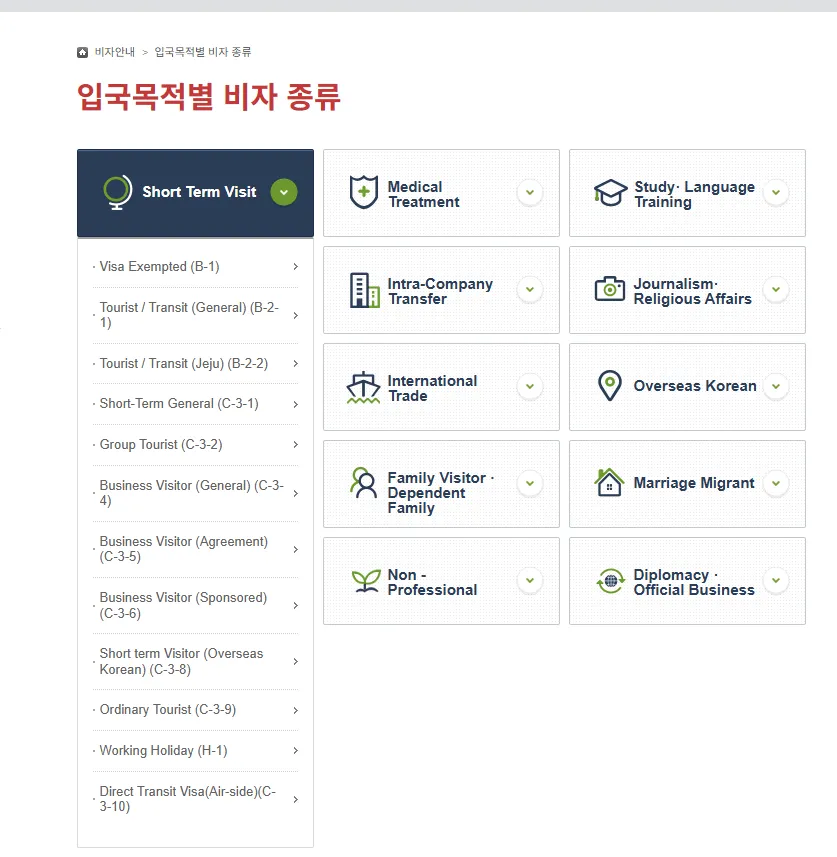
Business Visitor (General) C-3-4, (Agreement) C-3-5 and (Sponsored) C-3-6.
Open Professional, and C-4 is not with them:
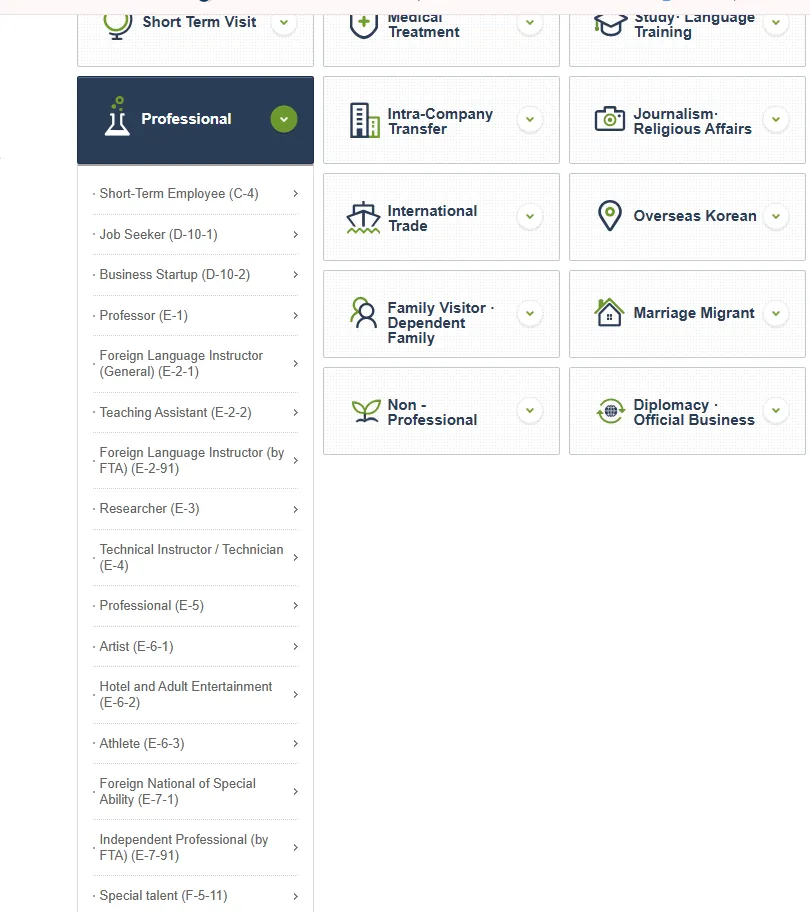
Short-Term Employee (C-4) heads a list that runs on through Professor (E-1), Researcher (E-3) and Technical Instructor (E-4). That is the company it keeps.
C-4 is filed with the work statuses. It is not a harder business visa; it is a short employment visa that happens to be brief.
C-3-4 — Business Visitor (General)
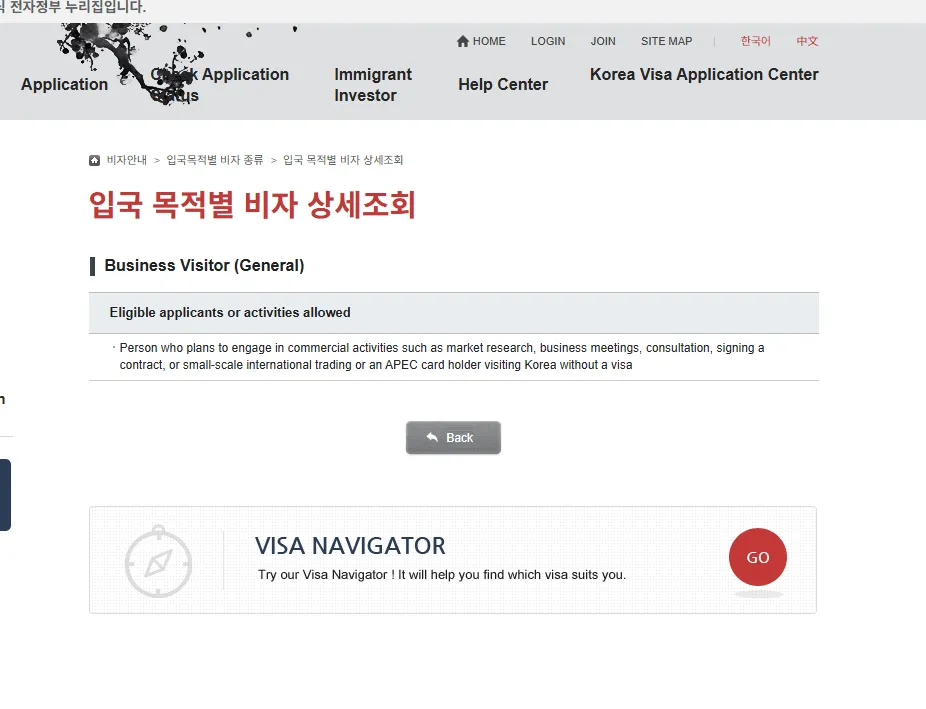
The portal's public wording. The manual behind it is more specific.
The portal lists market research, business meetings, consultation, signing a contract, small-scale international trading — and an APEC card holder entering without a visa. The Ministry’s manual uses the same list and then adds the part that decides hard cases:
Remuneration that does not exceed the cost of staying is included; a person whose purpose is profit-making is excluded.
So a stipend covering your hotel does not push you across the line. Coming to earn does.
Issued for 90 days, with three months of visa validity. The documents are the application, passport, photograph and fee, plus an invitation and evidence of the commercial purpose — typically the inviting company’s business registration certificate or corporate registry extract. Missions set their own list to suit local conditions.
The APEC card, spelled out
The manual gives the ABTC its own box: the scheme covers Korea, Japan, Australia, New Zealand, Hong Kong, the Philippines, Taiwan, Thailand, Malaysia, Brunei, Peru, Chile, China, Indonesia, Papua New Guinea, Singapore, Vietnam, Mexico and Russia. Korea treats a holder as C-3, 90 days, with the same effect as a multiple-entry visa.
It does not, however, excuse the arrival declaration — ABTC holders are named on the e-Arrival Card's must-file list.
The rule that decides most real cases
This is the paragraph worth sending to whoever books the flights.
⚠️ Installation, maintenance, fabrication, supervision
The manual states that where a foreign national is dispatched to a Korean public or private organisation for the installation or maintenance of imported machinery, shipbuilding, or the fabrication or supervision of industrial equipment, the activity is profit-making and falls outside the scope of the short-stay statuses B-1, B-2 and C-3. Such cases are to be issued C-4 short-term employment or D-9 trade management instead.
Read that against C-3-4’s own list and the boundary becomes usable rather than philosophical:
BUSINESS VISIT                      SHORT-TERM WORK
market research                     installing imported machinery
business contact                    maintaining or repairing it
consultation                        shipbuilding work
contract negotiation and signing    fabricating or supervising equipment
small-scale trading                 substantive services under a contract
Discussing the installation is on the left. Performing it is on the right. The same engineer can make both trips in the same year and need different routes for them.
And being paid abroad does not move you back
The manual anticipates the obvious workaround and closes it in a footnote to the C-4 activity list:
A person dispatched under a service contract, purchase contract, project contract or similar arrangement, to be paid remuneration-type expenses by a Korean public or private organisation — including a person who receives those expenses outside Korea rather than in it, where they provide substantive services or perform substantive work.
So “my Korean customer isn’t paying me, my employer in Stuttgart is” answers a question nobody asked. The test is what you do here, not where the money lands.
C-3-5 — Business Visitor (Agreement)
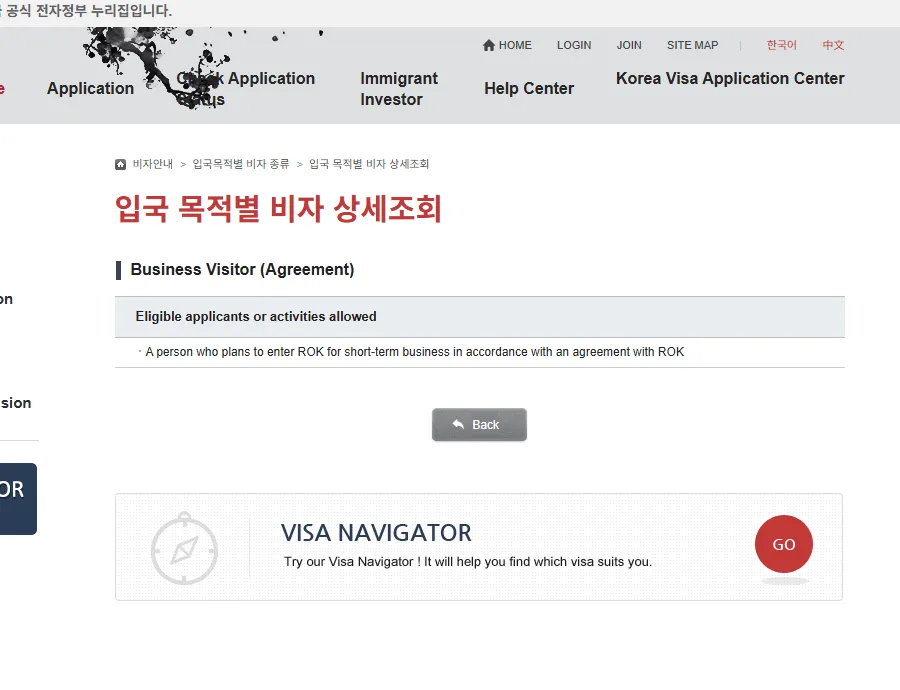
Not a longer C-3-4. A different basis, and the manual names which agreements.
Two agreements are named in the manual, and they are not interchangeable.
Under the Korea–India CEPA, the person covered is an employee of an Indian corporation visiting to negotiate the sale of goods or services, or to prepare the establishment of an investment company.
Under the Korea–Chile FTA, the activities named are research and design, manufacturing and production, marketing, sales, distribution, after-sales service and general services.
| Agreement | Stay | Visa validity |
|---|---|---|
| Korea–India CEPA | 90 days | 3 months |
| Korea–Chile FTA | 6 months | 3 months |
Note the Chile row: six months of stay, not 90 days, which is the sort of thing worth knowing before assuming every C-3 is a quarter.
You do not choose C-3-5 because the trip is short and business-related. Either an agreement covers you or it does not.
C-3-6 — Business Visitor (Sponsored)
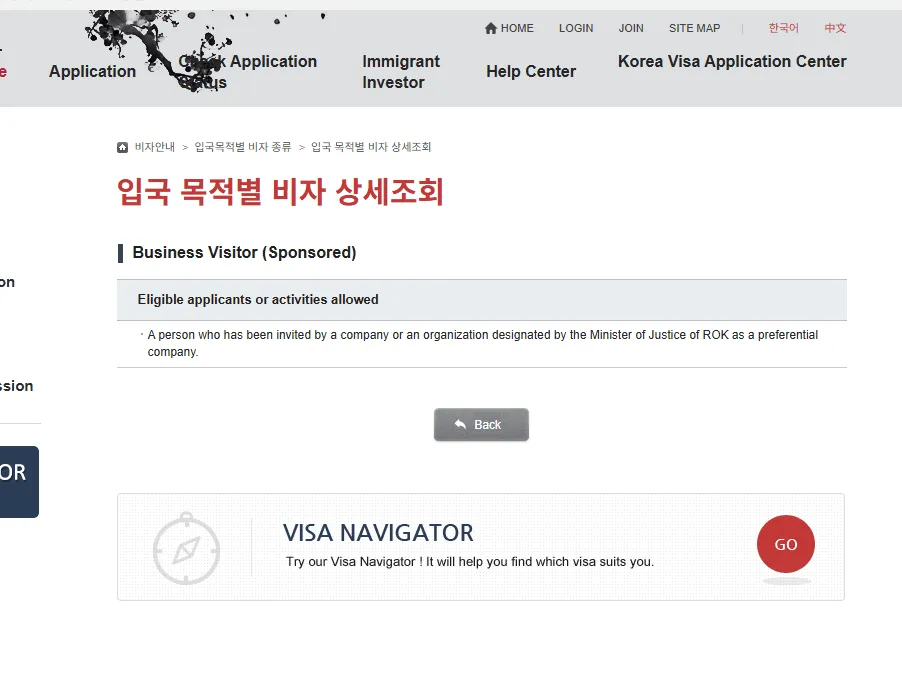
A structure, not a duration — and a closed one.
C-3-6 runs on an invitation, through the Visa Portal, from a company or organisation selected as a preferential company — selection requiring a recommendation from the Minister of SMEs and Startups, the chairman of the Korea Federation of SMEs, or the chairman of the Korea International Trade Association.
⚠️ Selection of new preferential companies has ended
The manual states it plainly: the route applies to firms already selected. A Korean company cannot decide today to become a C-3-6 sponsor, so if your host is not already on that list, this row is not yours.
For those it does cover: 90 days of stay, one year of validity, multiple entry, applied for as a Confirmation of Visa Issuance on Form No. 21, with the applicant’s employment certificate and an invitation issued by the preferential company. The sponsor files in Korea; the applicant then applies at a mission with the confirmation.
C-4 — Short-Term Employee
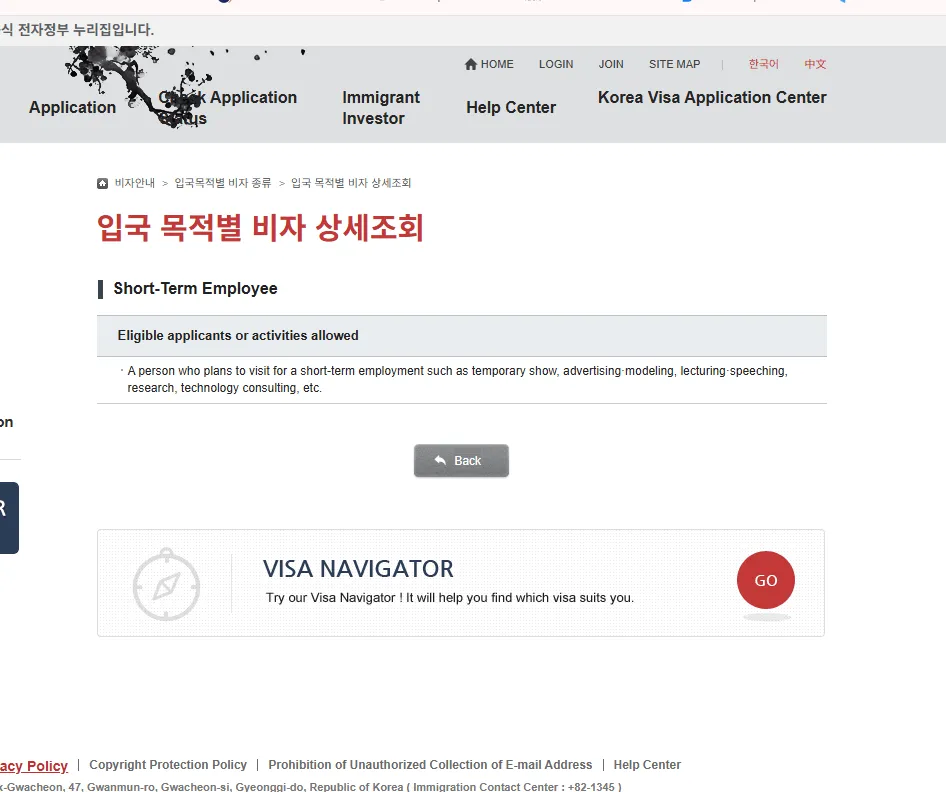
Defined as short-term activity for profit — which is the whole point.
Outside the seasonal-work subtypes, C-4-5 covers:
The cap on a single grant is 90 days. And one exclusion worth stating outright: simple manual labour does not qualify for C-4-5. C-4 is not a general-purpose short-term work permit.
For the machinery case, the manual asks for the underlying service, purchase or project contract and a dispatch or business-trip order on top of the usual application, passport, photograph and fee — and requires that the contract actually contain the installation obligation, and that the applicant hold the skills it needs.
The narrow exception for a public-interest talk
Not every paid-sounding lecture is C-4, but the exemption is tight and every condition has to hold at once:
Meet all four and a C-3, B-1 or B-2 holder can do it. A private company inviting you for a commercial purpose is C-4-5 regardless — the manual says so in the same breath.
Which is why “am I being paid?” is the wrong first question. Who invited you, why, under what arrangement, and for how much of your stay all sit above it.
Status and channel are two different questions
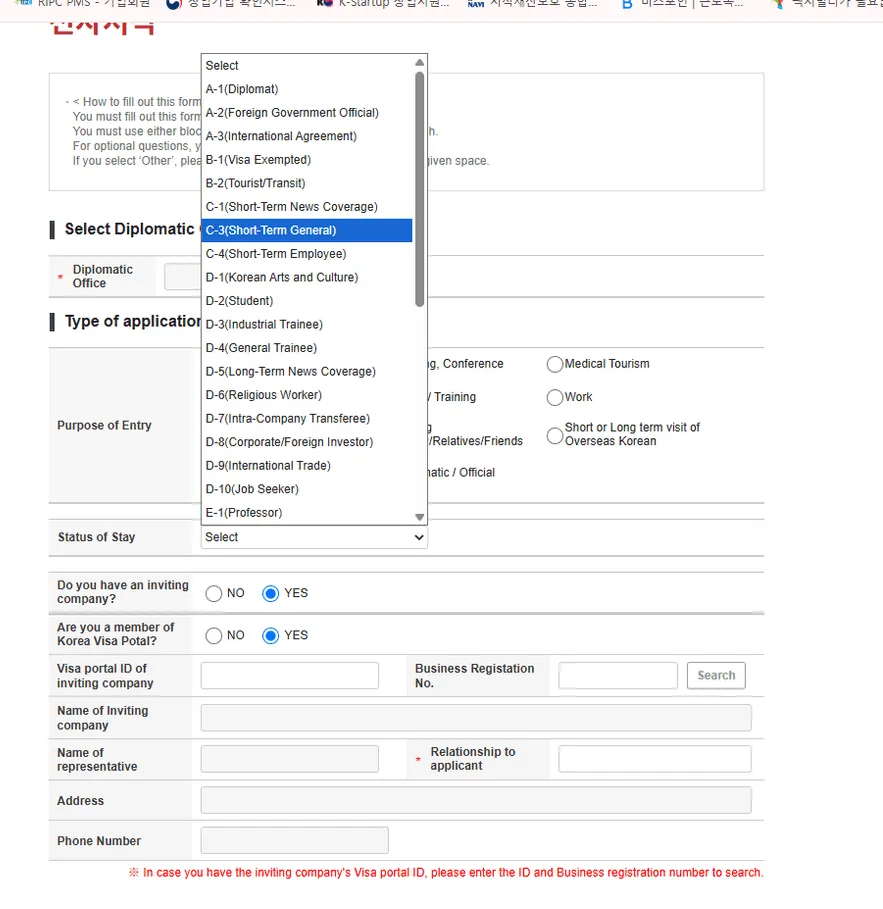
Separate radio buttons for Meeting, Conference, Business Trip and Work — then a separate Status of Stay list where C-3 and C-4 are different rows.
Note that the dropdown offers C-3 (Short-Term General), not C-3-4, C-3-5 and C-3-6 as separate items. Picking C-3 there does not settle which sub-category you end up in.
The same screen asks whether a Korean company is inviting you, and wants its Visa Portal ID, business registration number, name, representative and relationship to you:
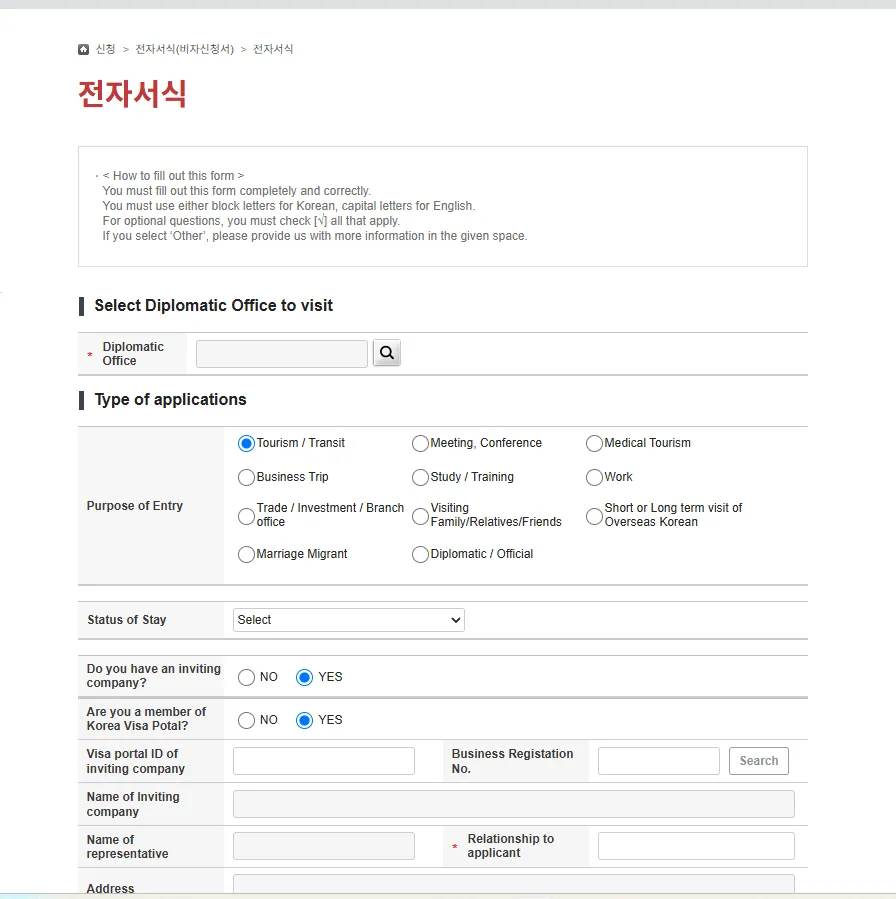
The Korean host is part of the application, not background to it.
e-Visa and e-Form are not the same thing
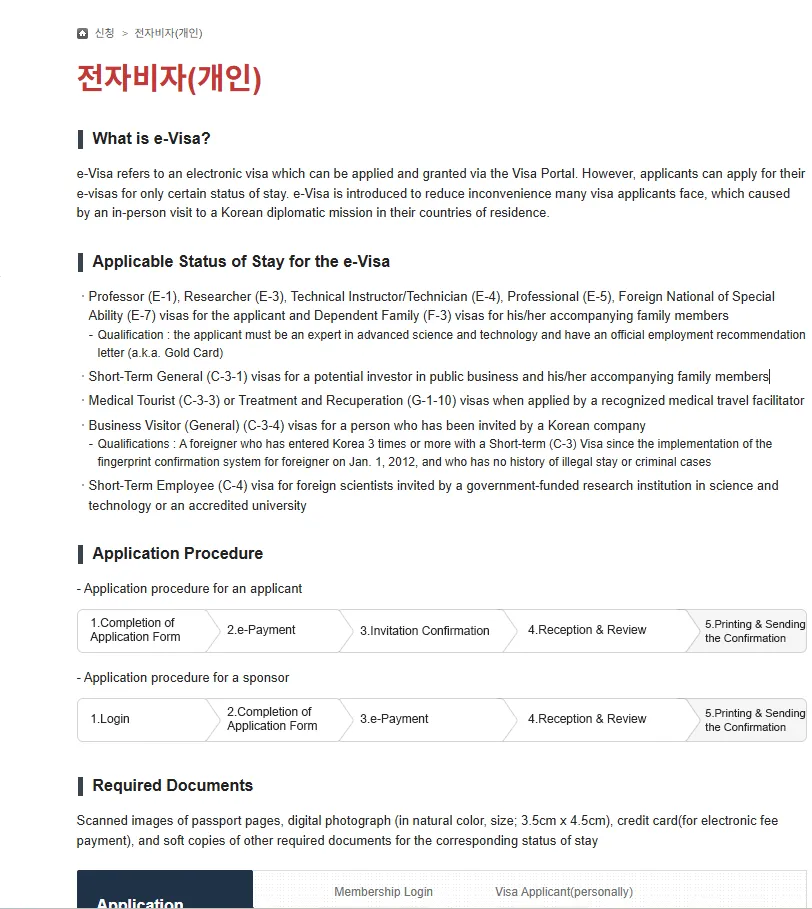
e-Visa exists to remove the in-person visit — for the statuses it covers.
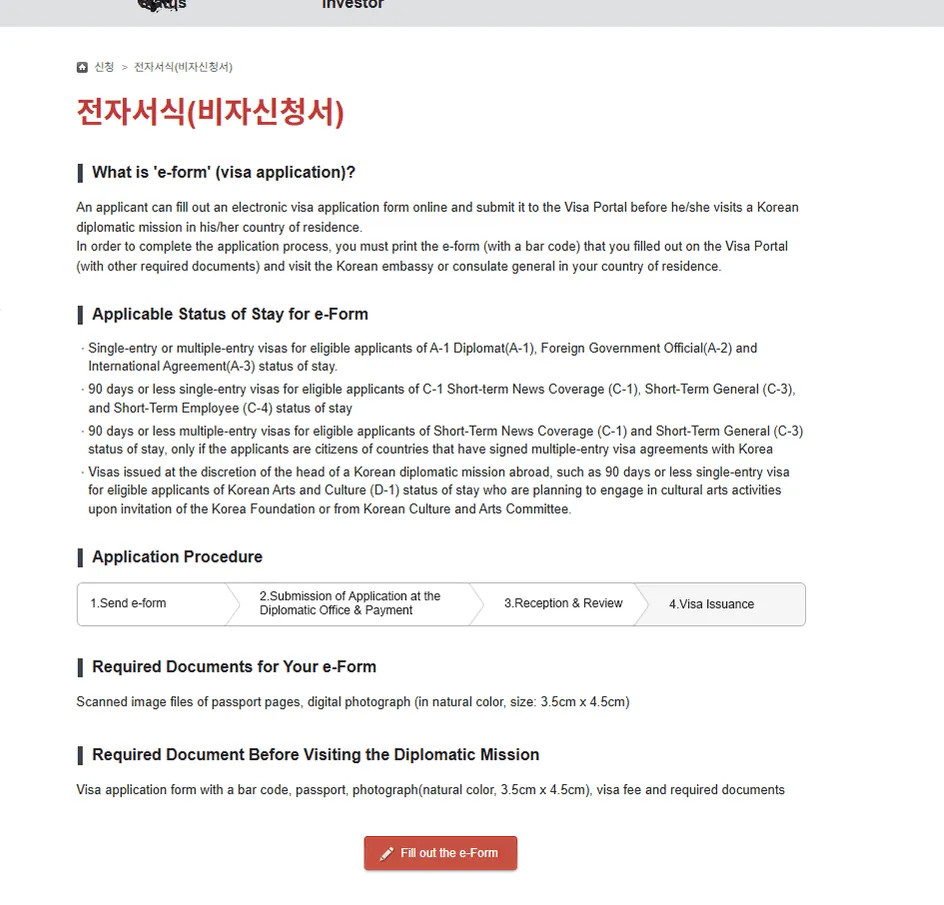
An e-Form is an online form. You print it with its barcode and take it to the consulate.
⚠️ The C-3-4 e-Visa condition belongs to the channel, not the visa
The frequent-business-traveller e-Visa route needs an invitation from a Korean company, three or more prior entries on C-3 status since 1 January 2012, and no record of illegal stay or other violations during them. It grants 90 days on a three-month single-entry visa.
That is not “you need three previous trips to get a C-3-4”. It is what one online channel requires. Which status fits your activity and which channel you may use are separate questions.
Which side is your trip on?
| What you will actually do in Korea | Look at |
|---|---|
| Business meeting, market research, consultation | Visa-free if eligible, otherwise C-3-4 |
| Negotiating or signing a contract | Visa-free if eligible, otherwise C-3-4 |
| Small-scale international trading | C-3-4 |
| Indian corporation, sales negotiation or investment set-up | C-3-5 (CEPA) |
| Research, design, production, marketing, distribution, after-sales | C-3-5 (Chile FTA) |
| Invited by an already-designated preferential company | C-3-6 |
| Installing imported machinery | C-4, or D-9 depending on the arrangement |
| Maintaining or repairing it | C-4 or D-9 |
| Shipbuilding, equipment fabrication or supervision | C-4 or D-9 |
| Substantive services under a contract | C-4 |
| Paid lecture or talk | C-4-5 |
| One-off talk for a non-profit, ≤5 institutions, ≤7 days | C-3 / B-1 / B-2 may work |
| Temporary performance, advertising or modelling | C-4-5 |
| Research or technical guidance for income | C-4-5 |
| Simple manual labour | Not C-4-5 — a different work status |
A routing aid, not a determination. The mission reviews the case, and the manual itself is explicit that offices may add to or subtract from its document lists.
Two things that do not work
⚠️ Entering on the easiest C and fixing it later
The application form states that category C visa holders cannot change their status of stay after entering Korea, under Article 9(1) of the Enforcement Regulations of the Immigration Act. C-3-4, C-3-5, C-3-6 and C-4 are all category C.
⚠️ Describing work as tourism
C-3-9 is the ordinary tourist route, not a fallback. The form warns that false information or documents lead to revocation of the visa and of permission to stay, and may bring criminal punishment and an entry ban.
The order to answer in
Do not run it backwards by choosing a convenient visa and describing the trip to fit.
Make the documents tell one story
Invitation, contract, dispatch order, application and the purpose ticked on the form should all describe the same trip: who invited the traveller, why, what will be performed, which contract requires it, how long it takes, and who is paying. Inconsistency between those is a problem you create for yourself.
Next
Entering on a visa puts you on the list of people who file the e-Arrival Card. If the entry check said visa-free instead, K-ETA is the thing to sort out.
The short version
Korea does not ask whether you are travelling for business. It asks whether you are coming to conduct business or to perform work, and it files those two answers in different parts of the system.
C-3-4 for market research, business contact, consultation, contracts and small-scale trading — with pay that does not exceed your costs, and not for profit. C-3-5 under the India CEPA or the Chile FTA. C-3-6 where an already-designated preferential company invites you. C-4 for profit-making short-term activity: performances, advertising, paid talks, research, technical guidance, and the installation and maintenance work that the manual names by hand.
And the sentence to take away, because it is the one most trips get wrong: work performed in Korea stays work even when you are paid abroad.
Frequently asked questions
- My salary is paid by my employer abroad. Doesn't that make it a business visit?
- No. The Ministry of Justice manual closes that exact gap: someone dispatched under a service, purchase or project contract who performs substantive services or substantive work in Korea falls inside short-term employment even where the remuneration-type expenses are paid outside Korea rather than in it. Where the money moves is not the test. What you physically do in Korea is.
- I am going to install a machine we sold to a Korean factory. Which route?
- Not the business-visitor one. The manual names this case directly — installation and maintenance of imported machinery, shipbuilding, and the fabrication or supervision of industrial equipment by someone dispatched to a Korean organisation — and calls it profit-making activity outside the scope of B-1, B-2 and C-3 short stays, to be handled as C-4 short-term employment or D-9 trade management. Meeting the buyer to discuss the installation is a business visit. Carrying it out is not.
- I am giving one talk at a Korean university. Do I need C-4?
- Possibly not, but the exemption is narrow and every condition has to hold at once. A one-off lecture, talk or advisory activity can be done on C-3, B-1 or B-2 only where the inviter is a government body, local authority, university, government-funded institute or other non-profit, inviting for academic or public-interest purposes; where you appear at no more than five Korean institutions during the stay; and where the lecturing or advisory activity totals no more than seven days. A private company inviting you for a commercial purpose is C-4-5, full stop.
- Which one covers a trip under a trade agreement?
- C-3-5, and the manual names the two live cases rather than leaving it abstract: the Korea–India CEPA, for an employee of an Indian corporation visiting to negotiate sales of goods or services or to prepare the establishment of an investment company; and the Korea–Chile FTA, for work in research and design, manufacturing and production, marketing, sales, distribution, after-sales service and general services. The Chile route carries six months of stay rather than 90 days.
- Can a Korean company become a C-3-6 sponsor for us?
- Not any more. C-3-6 runs on an invitation from a company or organisation already selected as a preferential company through the Visa Portal, and the manual states that selection of new preferential companies has ended. It applies to the firms already on the list. For everyone else the question does not arise.
Last verified:
Official sources
- Ministry of Justice, Korea Immigration Service — Visa Application Guide by Status of Stay (사증민원 자격별 안내 매뉴얼), September 2026
- Korea Visa Portal — Short Term Visit: Business Visitor (General, Agreement, Sponsored)
- Korea Visa Portal — Professional: Short-Term Employee (C-4)
- Korea Visa Portal — e-Visa, e-Form and Confirmation of Visa Issuance
Revision history
- Published
Figures here are re-checked against their official sources at least every six months. Substantive changes — a rate, a cap, a rule — are logged above rather than silently overwritten, and collected site-wide inupdates & revisions.
This article is general information, not financial, legal, or tax advice. Requirements and figures change; confirm the current rules with the official sources above before making decisions.