Korea C-3-9 Tourist Visa: Who Needs It and How to Apply
Published Last verified
If you are coming to Korea for a holiday and visa-free entry is not open to you, Ordinary Tourist (C-3-9) is the route to look at. That is the portal’s own English name for it — worth knowing, because “general tourist visa” is what most guides call it and it is not what the official list says.
But do not start by downloading the form. Start one question earlier: do you need a visa at all? For a great many passports the answer is no, and the whole exercise is unnecessary.
Before anything else
The Korea entry requirements check answers whether your passport is in scope for visa-free entry and for how long. If it is, your route is visa-free entry plus K-ETA where it applies — not this.
Korea sorts visas by purpose, not by length
The Visa Portal’s Visa by Categories screen is a grid of fifteen purposes: Short Term Visit, Medical Treatment, Study·Language Training, Professional, Intra-Company Transfer, Journalism·Religious Affairs, Investment, International Trade, Overseas Korean, Work and Visit, Family Visitor·Dependent Family, Marriage Migrant, Trainee, Non-Professional, and Diplomacy·Official Business.
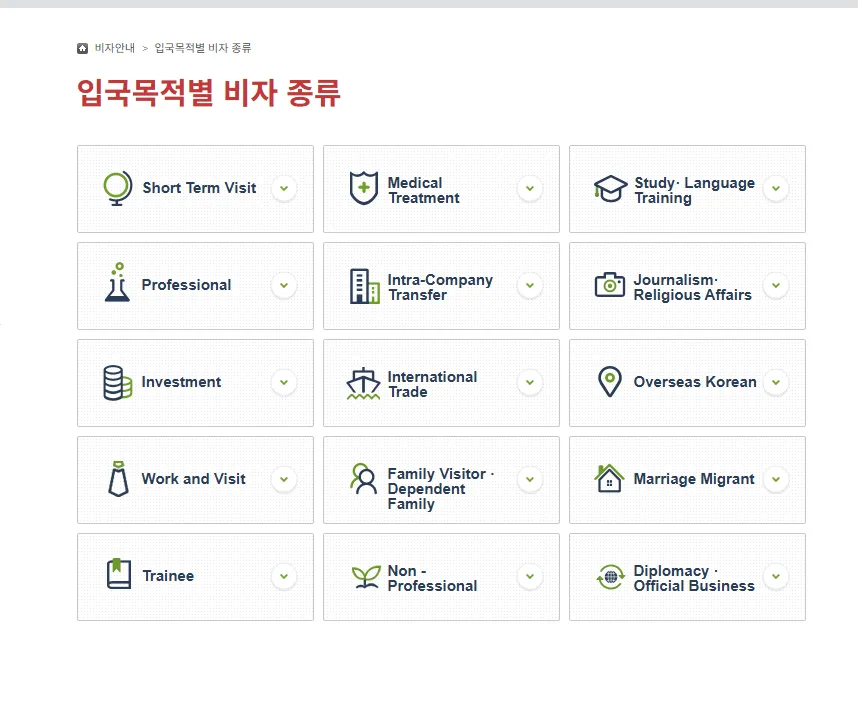
Fifteen purposes. A holiday is inside the first card, Short Term Visit — along with eleven other things.
Open that first card and it expands into a list that makes the point better than any explanation:
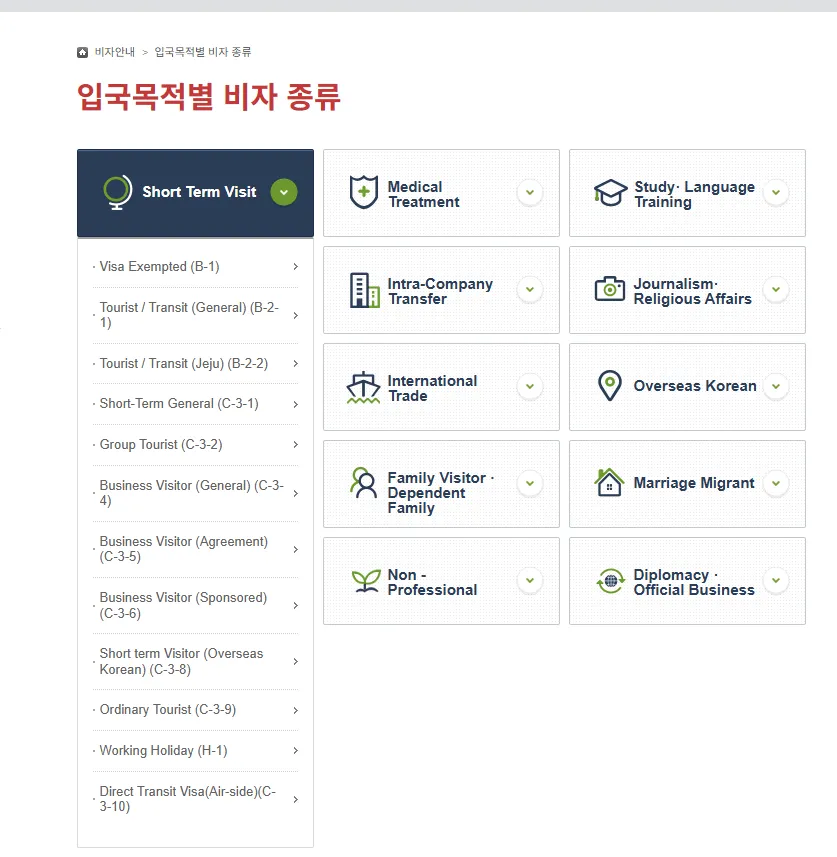
Twelve routes under one heading. Ordinary Tourist (C-3-9) is the tenth of them, not the default.
Visa Exempted                 B-1        Business Visitor (Agreement)   C-3-5
Tourist / Transit (General)   B-2-1      Business Visitor (Sponsored)   C-3-6
Tourist / Transit (Jeju)      B-2-2      Short term Visitor
Short-Term General            C-3-1        (Overseas Korean)            C-3-8
Group Tourist                 C-3-2      Ordinary Tourist               C-3-9
Business Visitor (General)    C-3-4      Working Holiday                H-1
                                         Direct Transit (Air-side)      C-3-10
Note what the three business rows are called: General, Agreement and Sponsored. Even inside business travel the portal splits by how the trip is arranged, not by how long it runs.
⚠️ “Under 90 days” is not a visa category
Six of those twelve are short stays. What separates them is what you will do — sightseeing, a business meeting, a commercial visit, transit, a working holiday. Picking C-3-9 because the trip is short is choosing the wrong one about half the time.
What C-3-9 actually covers
The portal’s entire published scope for Ordinary Tourist is one sentence:
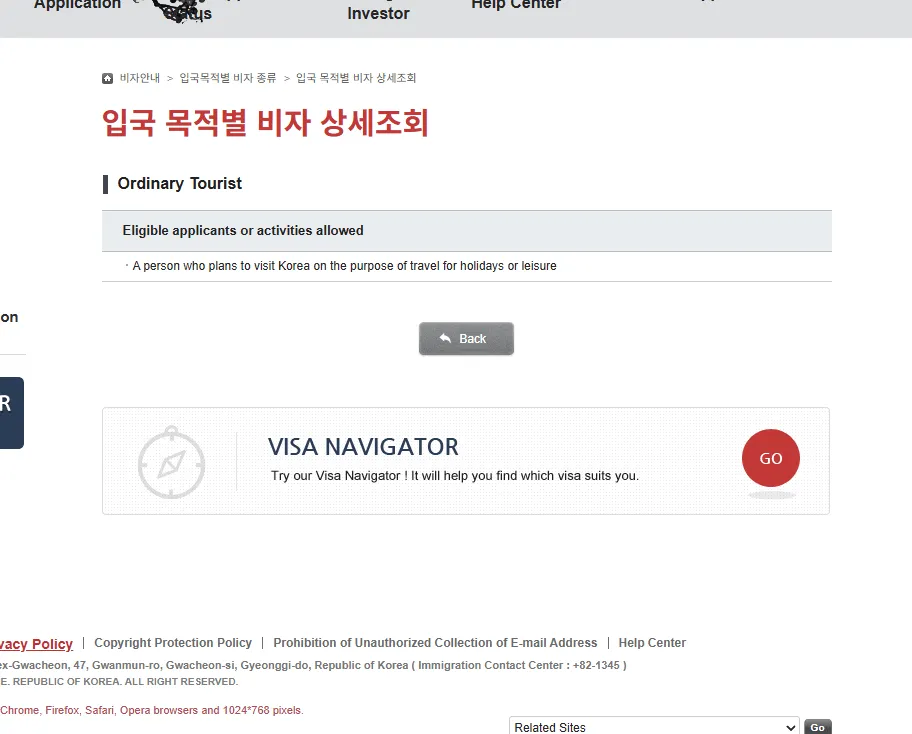
Under Eligible applicants or activities allowed, one line. That is the whole published scope.
A person who plans to visit Korea on the purpose of travel for holidays or leisure.
A holiday. Sightseeing. Leisure. If your reason for coming is a meeting, paid work, a trade visit or a course, a different row in that list is yours — and picking tourism because it looks like less paperwork is the mistake this whole page exists to prevent.
Four ways to apply, and a tourist can use one of them
The portal’s How to apply page lists four routes:
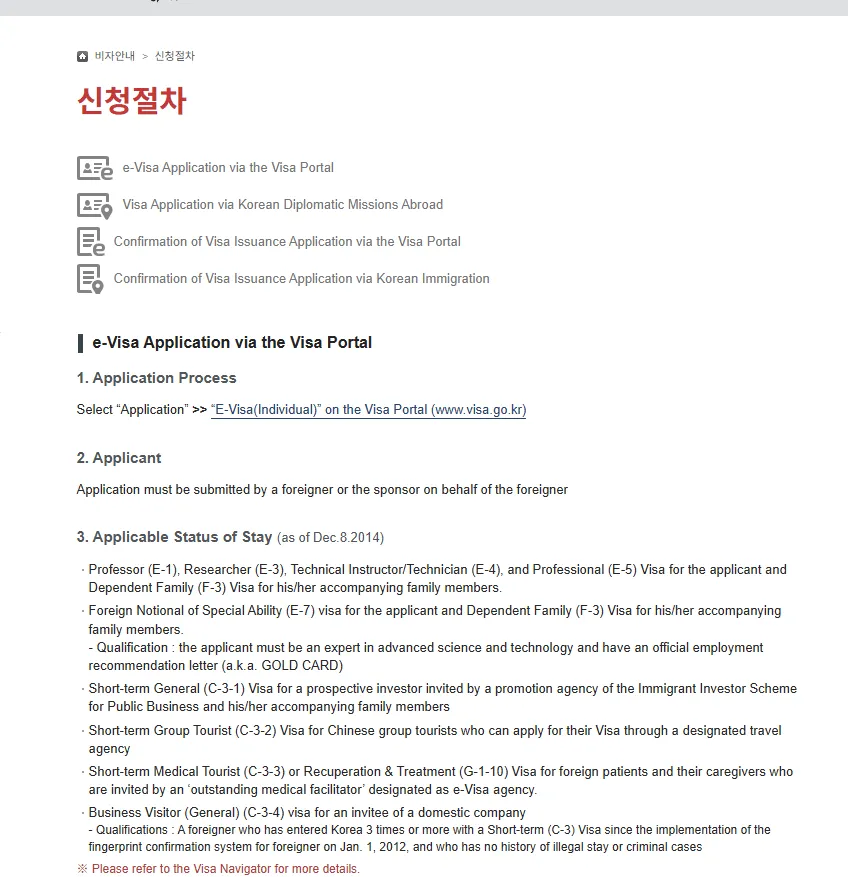
e-Visa, a diplomatic mission, and two Confirmation of Visa Issuance routes filed by a sponsor in Korea.
The e-Visa route is the one people hope for, and it is worth checking against its own list before you plan around it. The statuses it covers are E-1, E-3, E-4, E-5 and E-7 with dependants, plus C-3-1 for an invited prospective investor, C-3-2 for Chinese group tourists through a designated agency, C-3-3 for medical tourists with an approved facilitator, and C-3-4 for a business visitor invited by a domestic company.
⚠️ C-3-9 is not on the e-Visa list
General tourism is not one of the statuses that route covers. An ordinary holiday applicant applies through a Korean embassy or consulate — and the two Confirmation of Visa Issuance routes are filed by a sponsor in Korea, which a self-funded tourist does not have.
Applying through a mission
The place of application is the Korean embassy or consulate in your country or area of residence. Not the nearest, not the quickest — the one responsible for where you live.
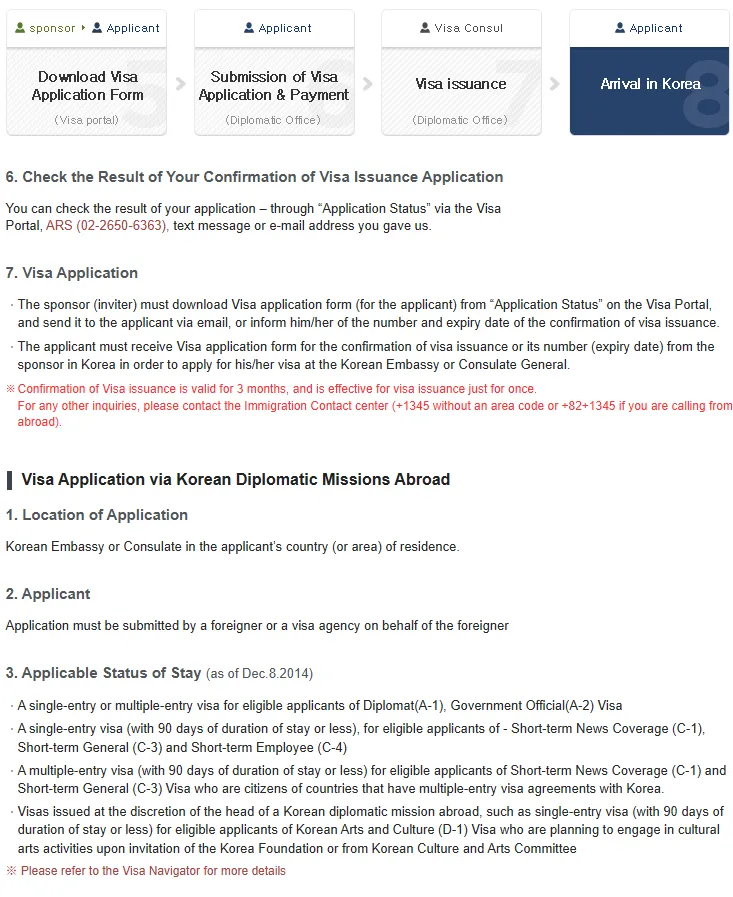
A single-entry visa of 90 days or less for C-1, C-3 and C-4. Multiple entry only for nationals of countries that have a multiple-entry agreement with Korea.
What that route wants is short: the visa application form (form No. 17, or the electronic form on the portal), your passport, a natural-colour photograph at 3.5 × 4.5 cm, the fee in US dollars, and the documents the status itself requires.
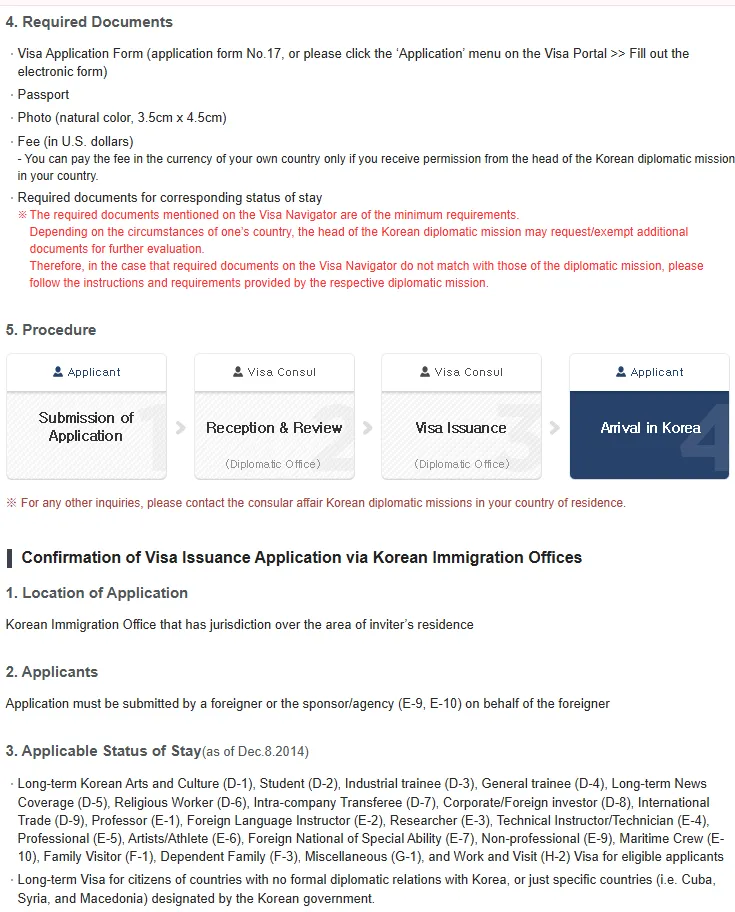
Note the process row at the foot: Submission → Reception & Review → Visa Issuance → Arrival. Submitting is not being issued.
Two details in there catch people. The fee is denominated in US dollars, and paying in your own currency needs the permission of the head of the mission. And the document list is a floor, not a ceiling — in the portal’s own words:
⚠️ The mission's list wins
“The required documents mentioned on the Visa Navigator are of the minimum requirements. Depending on the circumstances of one's country, the head of the Korean diplomatic mission may request/exempt additional documents for further evaluation. Therefore, in the case that required documents on the Visa Navigator do not match with those of the diplomatic mission, please follow the instructions and requirements provided by the respective diplomatic mission.”
Which is why a checklist copied from a different country's Korean consulate is not your checklist. It looks authoritative and it is wrong for you.
That is also why there is no fee figure and no processing time in this guide. Both are set by the mission handling your application, and a number lifted from somewhere else is worse than no number.
One thing to check for yourself
The portal dates its eligible-status lists “as of Dec. 8. 2014”. They are the current published lists, but they carry that date — so confirm anything decision-critical with your own mission rather than with the date stamp.
The form is five pages
The current form is the VISA APPLICATION FORM prescribed under the Enforcement Regulations of the Immigration Act. It is bilingual, Korean above English, and it opens with its own instructions: complete every item, write in Korean or English, tick every box that applies, and explain anything answered “Other”.
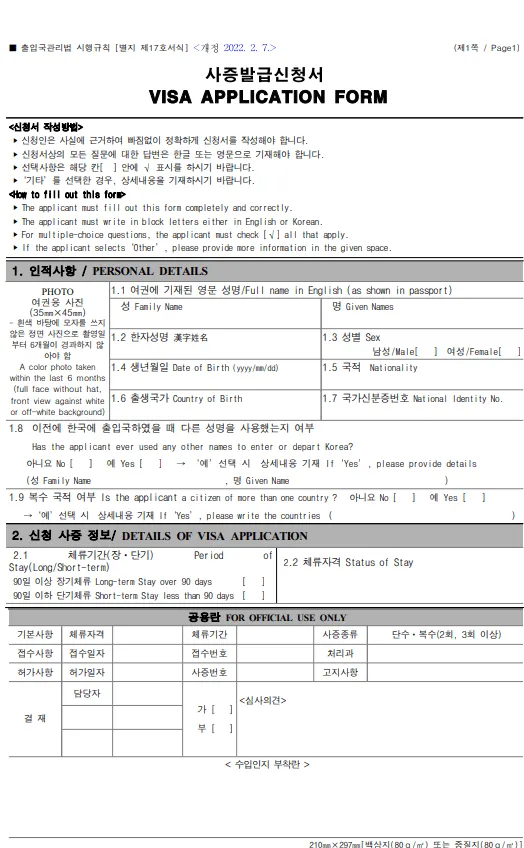
Page 1. The photo is 35 × 45 mm — the portal writes the same size as 3.5 × 4.5 cm — taken within the last six months, full face, no hat, white or off-white background.
Page 1 also splits the application at the top: long-term stay over 90 days or short-term stay less than 90 days, then the status of stay you are applying for. Page 2 takes passport details, contact details, an emergency contact, marital status and education.
Page 3 opens with employment — Entrepreneur, Self-Employed, Employed, Civil Servant, Student, Retired, Unemployed, Other — and then reaches the section that matters most for a tourist.
Section 8: Details of Visit
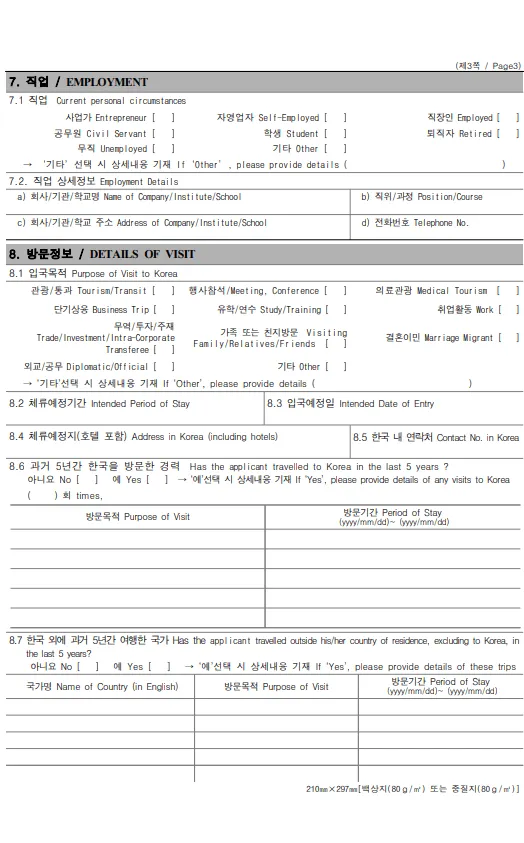
One page carries the purpose, the dates, the Korean address and five years of travel history.
8.1 Purpose of Visit to Korea offers eleven boxes:
Tourism/Transit                              Work
Meeting, Conference                          Trade/Investment/Intra-Corporate Transferee
Medical Tourism                              Visiting Family/Relatives/Friends
Business Trip                                Marriage Migrant
Study/Training                               Diplomatic/Official
                                             Other
For a C-3-9 application, Tourism/Transit is the box. But tick the one that is true: Business Trip and Meeting, Conference are separate boxes for a reason, and so is Work.
The rest of the section is short and literal:
Answer 8.6 and 8.7 fully. They ask about travel, not about relevance — leaving out a trip because it had nothing to do with this one is not what the question says.
Page 4 carries family in Korea, family travelling with you, and whether anyone is inviting you, then funding: estimated costs in US dollars, who is paying, their relationship to you, and how. Keep that consistent with whatever financial evidence your mission asks for. The form then asks whether anyone helped you complete it, and for their details if so.
Page 5 is the page to read twice
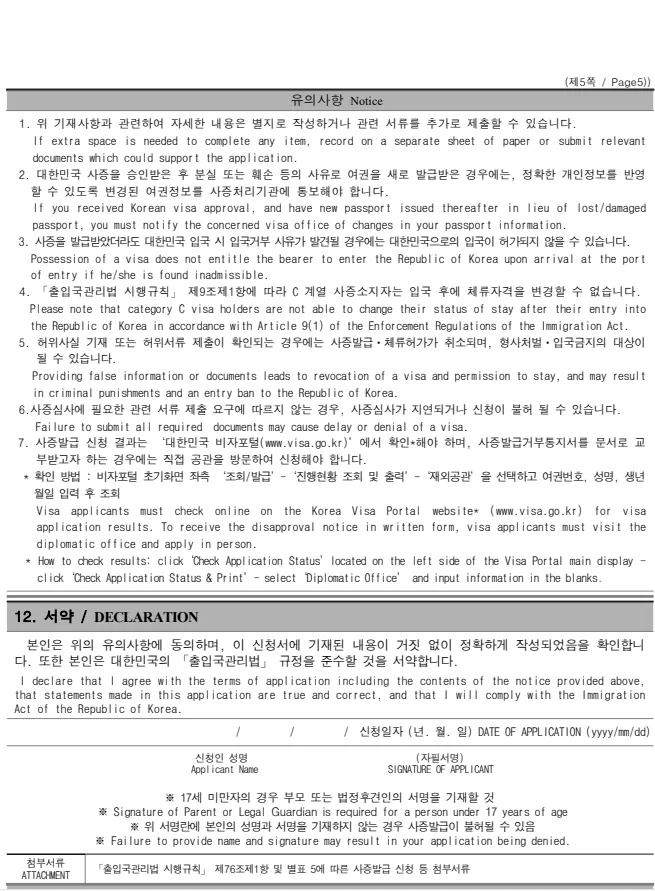
Seven numbered notices, then the declaration and signature.
Three of the seven decide things.
⚠️ A visa is not admission
“Possession of a visa does not entitle the bearer to enter the Republic of Korea upon arrival at the port of entry if he/she is found inadmissible.” Two decisions, two offices. The consulate issues; the officer at the border admits.
⚠️ C means no change of status afterwards
“Please note that category C visa holders are not able to change their status of stay after their entry into the Republic of Korea in accordance with Article 9(1) of the Enforcement Regulations of the Immigration Act.”
This is the line that costs people the most. Arriving on a tourist route intending to convert to work or study once you are here does not work — the conversion is not available to category C. Choose the route before you fly.
The third: false information or documents leads to revocation of the visa and of permission to stay, and may result in criminal punishment and an entry ban. Failing to submit requested documents can delay the review or end it in a refusal.
Results are checked on the Visa Portal — Check Application Status, then Check Application Status & Print, then Diplomatic Office, then your passport and personal details. A written disapproval notice has to be collected from the mission in person.
Then sign and date it. A person under 17 needs a parent’s or legal guardian’s signature, and the form warns that a missing name or signature can be enough on its own for the application to be denied.
Before you submit
After the visa, one more filing
A Korean visa and the e-Arrival Card are different things, and holding the first does not settle the second. Entering on a visa puts you on the list of people who file the arrival declaration — visa holders are its first entry.
Next
How to fill out the e-Arrival Card, field by field. And if the entry check said visa-free after all, how to apply for K-ETA instead.
The short version
C-3-9 — Ordinary Tourist — is the route for people a visa-free scheme does not cover. The form is five pages and the two lines that matter are both on the last one: a visa is not admission, and category C cannot change status afterwards.
Everything else follows from one question, and it is not “which visa is easiest” — it is what you are actually going to do in Korea.
Frequently asked questions
- Do I need C-3-9 at all?
- Check that first, because for many nationalities the answer is no. If your passport is in scope for visa-free entry, your route is visa-free entry plus K-ETA where it applies, and no visa application at all. The visa is the route for people that scheme does not cover, or whose purpose or length of stay puts them outside it. Settling this before you download a form saves the whole exercise.
- Can I enter on C-3-9 and change to a work or study visa later?
- No, and the application form says so on its own notice page: category C visa holders are not able to change their status of stay after their entry into the Republic of Korea, under Article 9(1) of the Enforcement Regulations of the Immigration Act. This is the single most consequential line on the form for anyone thinking of arriving as a tourist and sorting the rest out in Korea. Pick the route that matches what you are actually going to do, before you travel.
- Which supporting documents do I need?
- Ask the Korean embassy or consulate with jurisdiction over where you live, and take their current list over any other. The portal gives a common framework — form, passport, photograph, fee, and whatever the status itself requires — while stating that missions adjust the requirements to local circumstances. This is where copied checklists go wrong: one mission's list is presented as a worldwide rule, and it is not.
- How much is it and how long does it take?
- Both are set by the mission handling your application, which is why this guide does not print a figure for either. A number copied from another country's Korean consulate is worse than no number, because it looks authoritative while being wrong for you. Check your own mission's current notice.
- Does a visa mean I will be let in?
- No — and again the form says it outright: possession of a visa does not entitle the bearer to enter the Republic of Korea upon arrival at the port of entry if he or she is found inadmissible. Issuing a visa and admitting you at the border are two decisions made by two different offices. Nothing on any form, and nothing in this guide, changes the second one.
Last verified:
Official sources
- Korea Visa Portal — visa types by purpose of entry
- Korea Visa Portal — How to apply: e-Visa, diplomatic missions, and Confirmation of Visa Issuance
- Korea Visa Portal — Visa Application Form, prescribed under the Enforcement Regulations of the Immigration Act
- K-ETA — eligible countries and permitted period of stay
- Korea e-Arrival Card — individuals subject to and excluded from declaration
Revision history
- Published
Figures here are re-checked against their official sources at least every six months. Substantive changes — a rate, a cap, a rule — are logged above rather than silently overwritten, and collected site-wide inupdates & revisions.
This article is general information, not financial, legal, or tax advice. Requirements and figures change; confirm the current rules with the official sources above before making decisions.