How to Register as a Foreign Resident in Korea
Published Last verified
Getting your visa is the first step, not the last one. A visa is permission to enter Korea under a particular status. Foreign resident registration is a separate procedure, done after you arrive, that records your long-term residence and ties your passport, status of stay and Korean address into the immigration system.
Three things people get wrong
All three are stated on the government's own screens
Everything below is the procedure those three facts sit inside.
The 90-day clock, and why it is not a three-month grace period
The 2026 sojourn manual applies the same rule across statuses: a person intending to stay 90 days or longer must complete foreign registration within 90 days of the date of entry. The manual states it plainly in the general notice to applicants, and repeats it in the status-specific procedures — for F-1 visiting and F-3 accompanying family, for example, it appears as the first line of the residence-management steps.
Exemptions and status-specific rules exist, so the first thing to check is whether your own status requires registration at all. But if it does, treat 90 days as the outer limit rather than the plan. The sequence that works is:
enter Korea → settle your address → check your status documents →
book the office visit → prepare Form 34 → attend → register
The reason to book early is not politeness. A HiKorea reservation is an appointment, and appointments run out.
Form 34 is ten different applications
The form you will fill in is the Integrated Application Form (Report Form), Form No. 34 under the Enforcement Rule of the Immigration Act, revised 12 April 2022. It can be completed in Korean or English.
Open it and the first thing to do is choose which application it is. There are ten boxes, and only the first is first-time registration:
| The box | What it is |
|---|---|
| Foreign Resident Registration | First-time registration — the one this guide is about |
| Reissuance of Registration Card | A replacement card |
| Extension of Sojourn Period | More time on the status you hold |
| Change of Status of Sojourn | A different status |
| Granting Status of Sojourn | Being given a status you did not enter on |
| Engage in Activities Not Covered by the Status of Sojourn | Permission to do something your status does not cover |
| Change or Addition of Workplace | A new or additional employer |
| Reentry Permit (Single, Multiple) | Leaving and coming back |
| Alteration of Residence | You moved |
| Change of Information on Registration | Your name, passport or nationality changed |
Tick the wrong one and you have filed something you did not mean to file.
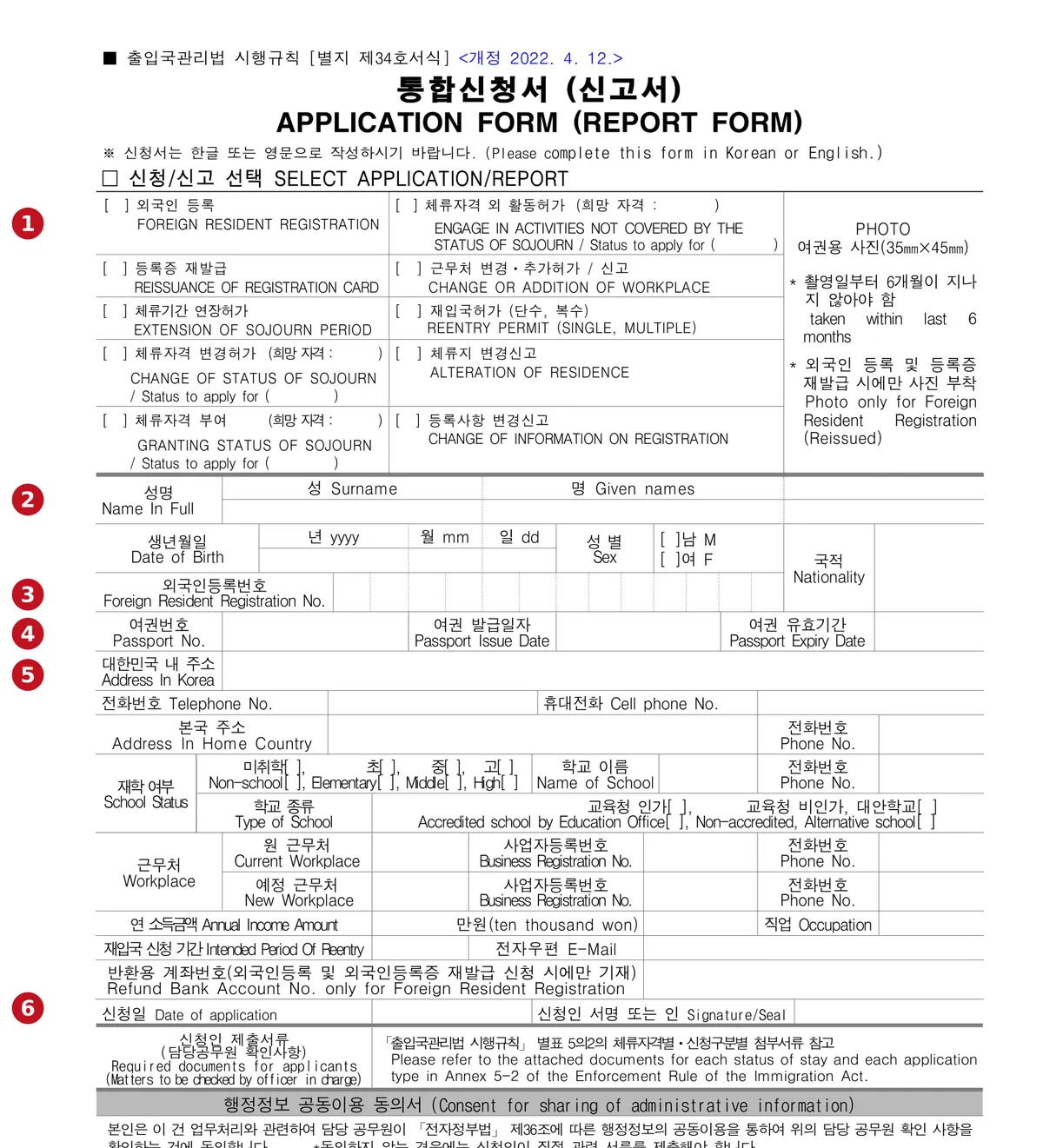
① The box to tick — Foreign Resident Registration, first of the ten. ② Name in full, spelled exactly as your passport spells it. ③ Foreign Resident Registration No. — you do not have one yet, so this stays empty on a first application. ④ Passport number, issue date and expiry date. ⑤ Address in Korea — the one your proof of residence has to match. ⑥ Date and signature. The markers are ours, in the gutter; nothing on the form has been altered or filled in.
The form also asks for telephone and mobile number, your address in your home country, school status, workplace and business registration number, annual income, occupation, email, and — for registration and card reissuance only — a refund bank account number. Applicants with a job or a school place should have those details to hand before they start.
The photo rule, and a translation that trips people up
The photo panel asks for a passport-style photo, 35mm × 45mm, taken within the last six months. Its English line reads "Photo only for Foreign Resident Registration (Reissued)", which is easy to read as reissues only. The Korean says 외국인 등록 및 등록증 재발급 — registration and card reissuance. Bring the photo for a first registration.
Step 1 — HiKorea, and the tile you are looking for
Booking the office visit happens on HiKorea. On the English home page the service panel carries Reserve Visit first, alongside Petition Application, Smart Entry Service and the rest.

Reserve Visit → Apply. You do not start from the visa section — that stage is over.
What a Visit Reservation actually is
The Ministry of Justice guidance defines it in one line, and then answers the question everyone actually has:
Is it mandatory to make a reservation to visit?
Yes, that’s right. The visit reservation system has been implemented as of April 2021 at immigration offices across the nation, and applications are not accepted if you visit the office without making a prior reservation.
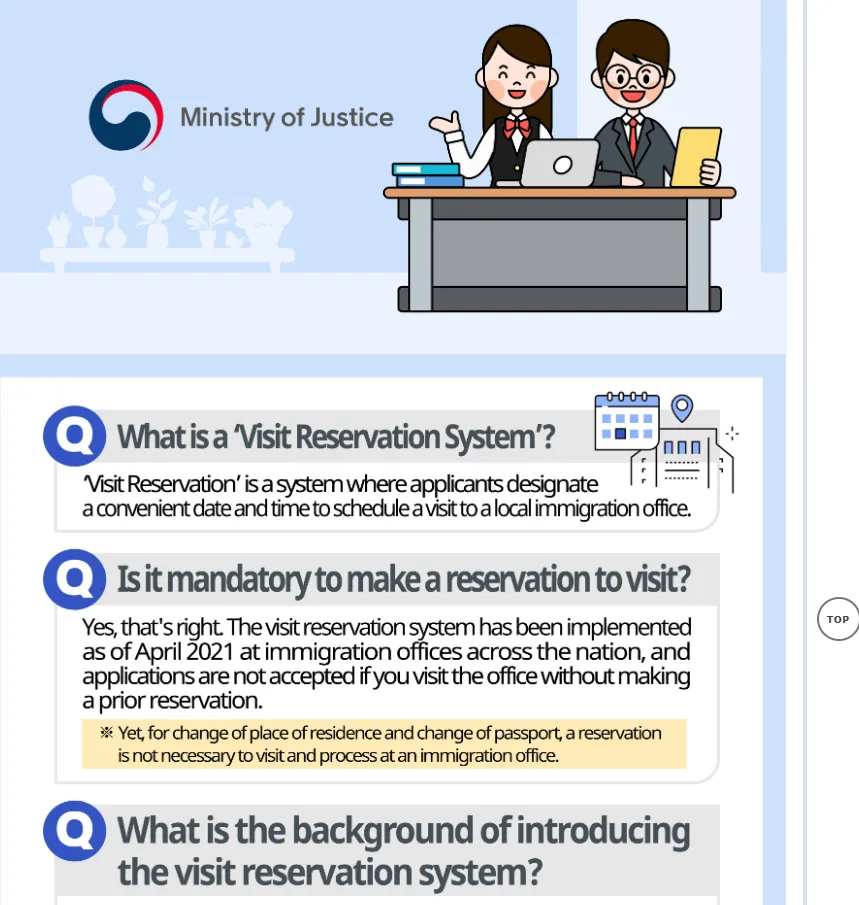
Note the yellow line under the answer. It is the part most guides leave out.
That yellow line is the exception, and it is worth knowing before you spend an afternoon hunting for a slot:
※ Yet, for change of place of residence and change of passport, a reservation is not necessary to visit and process at an immigration office.
So the rule is “book first” for registration, extension, status change and the rest — but if you have moved house or replaced your passport, you can go.
The warnings on the booking page are not boilerplate
Before the booking form, HiKorea puts up an Important Note for Reservation. Four numbered points, two of them in red.
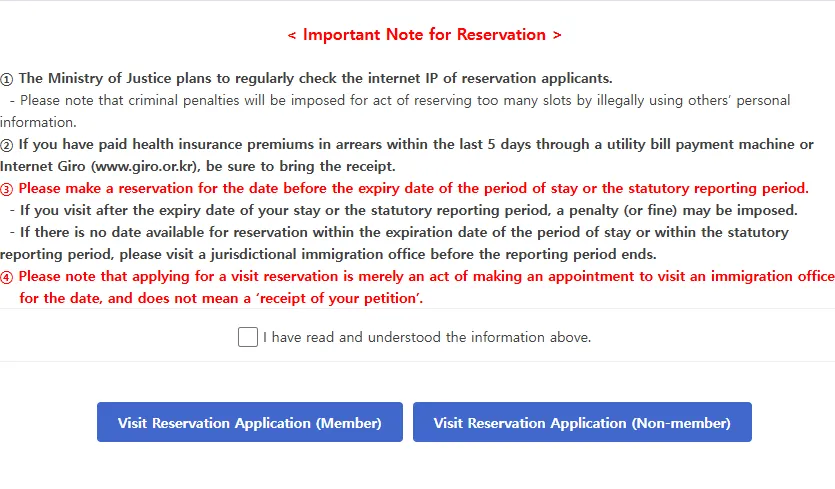
The red points are the two that cost people money. Below them, the member and non-member routes.
The third point is the deadline one:
③ Please make a reservation for the date before the expiry date of the period of stay or the statutory reporting period.
– If you visit after the expiry date of your stay or the statutory reporting period, a penalty (or fine) may be imposed.
– If there is no date available for reservation within the expiration date of the period of stay or within the statutory reporting period, please visit a jurisdictional immigration office before the reporting period ends.
Read the second dash twice. “There was no appointment” is not a defence, and the instruction when the calendar is full is to turn up anyway.
The fourth point is the one that catches first-timers:
④ Please note that applying for a visit reservation is merely an act of making an appointment to visit an immigration office for the date, and does not mean a ‘receipt of your petition’.
Do not book with someone else's details
The reservation guide warns that using another person's personal information — a passport number or an alien registration number — can bring criminal penalties under the Personal Information Protection Act and the Criminal Act, with up to five years' imprisonment or a fine of up to 50 million KRW. It also says the Ministry checks the IP addresses of reservation applicants, and that reservation data from illegally pre-occupied slots is analysed and referred to the investigative authorities.
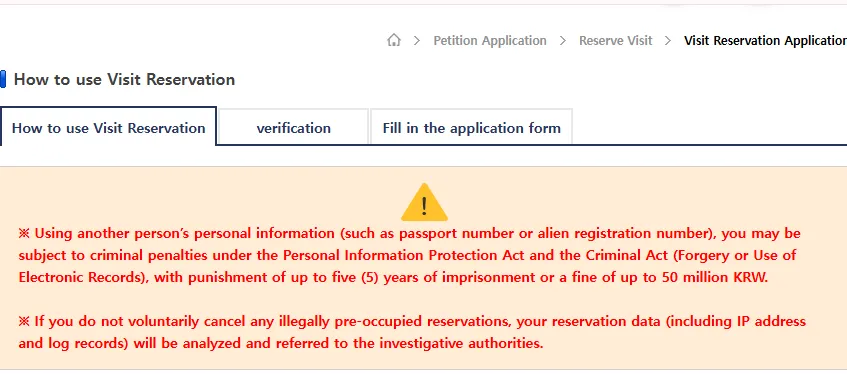
On the reservation guide itself, above the fold.
Member or non-member
HiKorea offers both: Visit Reservation Application (Member) and Visit Reservation Application (Non-member). An account is not the only route, which matters if you landed last week and have not built a Korean online identity yet.
Choosing the right identity-verification tab
This is where a first-time applicant most often gets stuck. The non-member route offers three verification methods, on three tabs, and the default is the wrong one for you.
The default tab asks for a Registration Number and a date of issuance — which assumes you already hold a Korean foreign resident registration number.
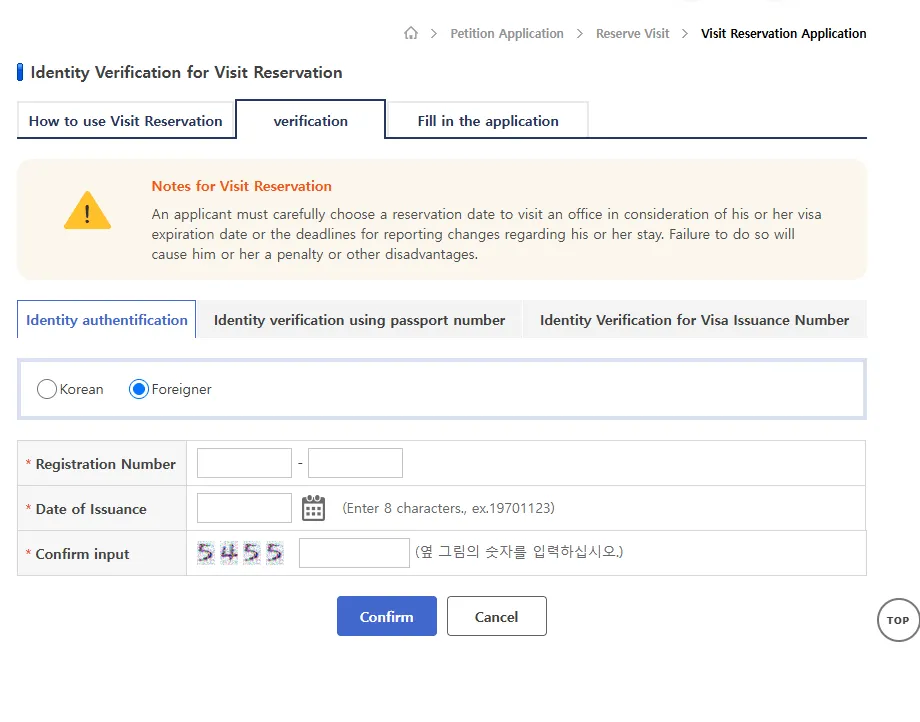
Fine for a renewal. Useless on a first application, because the number it wants is the one you are applying for.
The second tab is the one to use. Identity verification using passport number asks for your passport number, nationality, date of birth and the verification code.
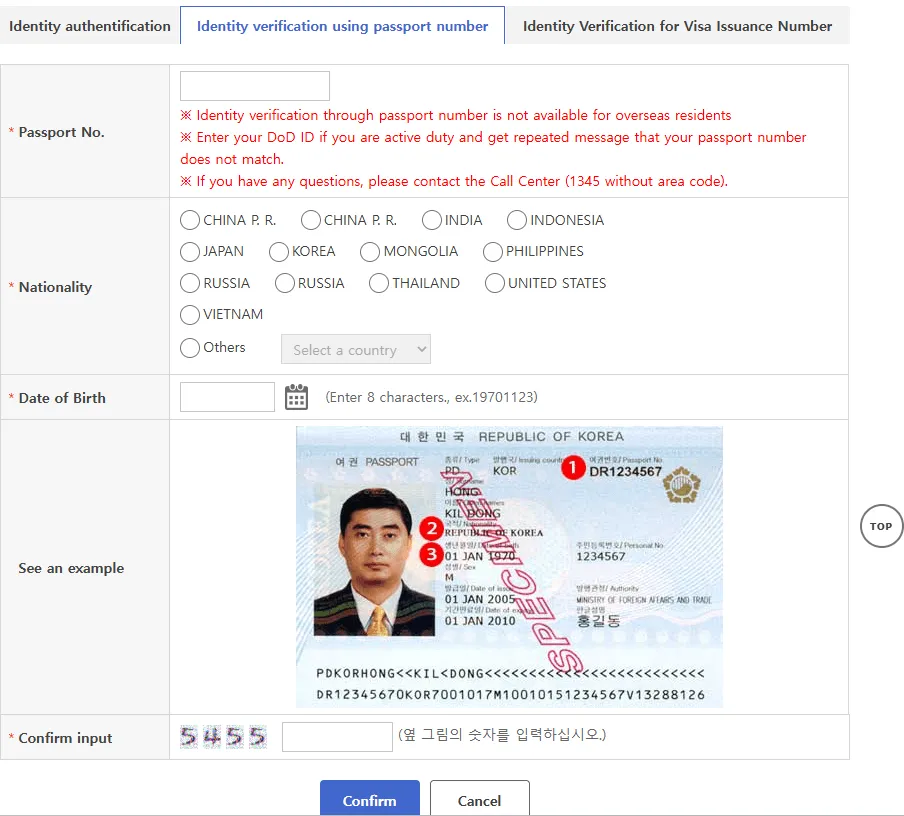
The specimen is HiKorea's own, stamped SPECIMEN and made out to 홍길동 — Korea's John Doe. Its red ①②③ mark the three fields you copy: passport number, nationality, date of birth.
Two details on that screen are worth reading before you type. It states that passport-number verification is not available for overseas residents — one more reason this is a post-arrival procedure. And it tells active-duty applicants to enter their DoD ID if the passport number keeps coming back as not matching.
The third tab, Identity Verification for Visa Issuance Number, exists for applicants who have that number and want to authenticate with it. It asks for the number, your name and your date of birth.
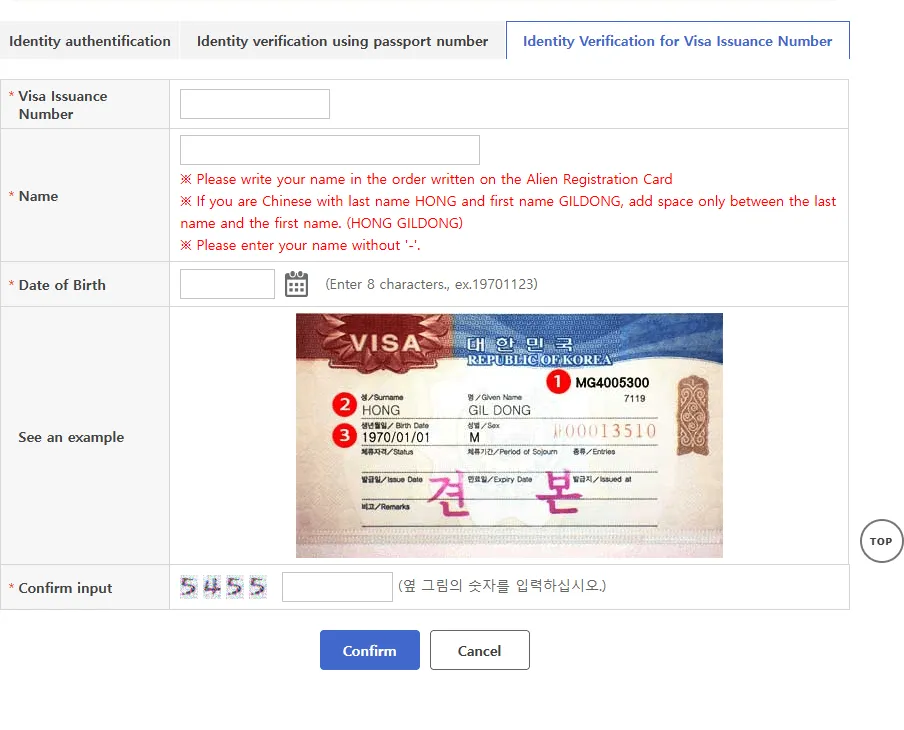
Not everyone uses this route. Note the naming instruction: write your name in the order shown on the Alien Registration Card, with no hyphen.
The point is not that one tab is correct for everybody. It is that HiKorea does not offer a single route, and the default is not the one a new arrival needs.
The documents: two layers, not one
The 2026 manual lists a recurring base set across statuses — for F-1 and F-3 residence management, for instance, it reads: passport, Integrated Application Form, one standard photograph, documents proving the family relationship, the fee, and documents proving the place of residence.
Strip out the status-specific item and the common core is:
| Layer | What |
|---|---|
| Common | Form No. 34, passport, standard photograph, fee, proof of residence |
| Status-specific | Whatever your status requires — school, employment, business registration, family, health |
Form 34 itself points at the second layer, in a line printed on the form: applicants are told to refer to the documents required for each status of stay and each application type in Annex 5-2 of the Enforcement Rule.
A D-2 student, an E-2 teacher, a D-8 investor and an F-3 dependent are all applying for the same card on the same form, and none of them brings the same envelope. A checklist written for someone else’s status is not a checklist for yours.
Proof of residence is a document, not an address
The manual asks for evidence of where you actually live, not a line you write on a form. If the lease is in your name, that part is straightforward.
Plenty of new arrivals are not in that position. Company housing, a dormitory, a flat the employer rents, a room in a relative’s home, someone else’s lease — in all of those the tenancy paperwork names somebody else. That is what the Confirmation of Residence/Accommodation form is for.
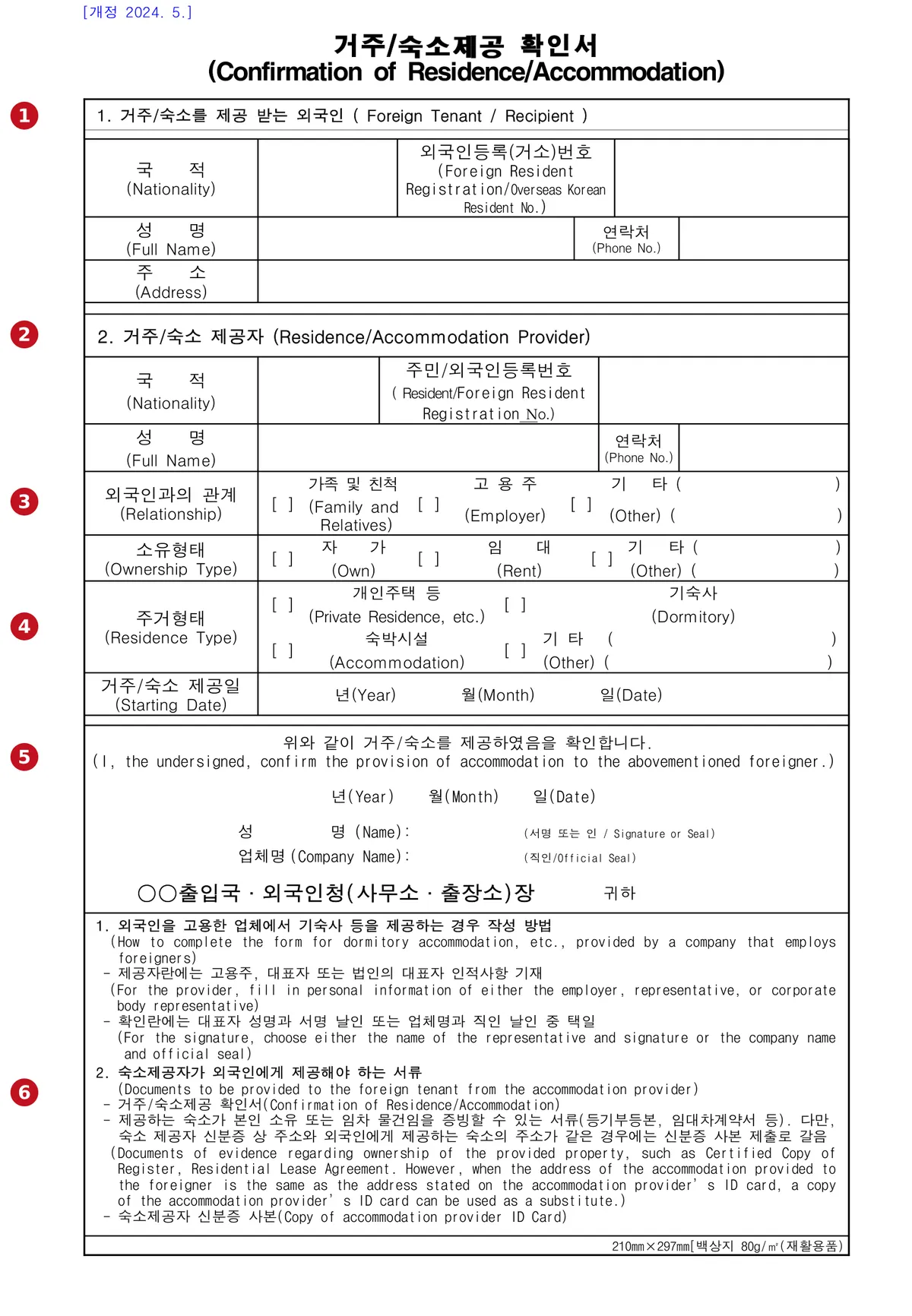
① Section 1 — you: nationality, registration number if you have one, name, phone, address. ② Section 2 — whoever provides the accommodation. ③ Relationship: family and relatives, employer, or other. ④ Residence type: private residence, dormitory, accommodation facility, or other. ⑤ The confirmation: name and signature, or company name and official seal. ⑥ The documents the provider owes you. Markers ours; the form is unaltered.
If your employer provides the housing
The form carries its own instructions for exactly this case. Where a company employing the foreigner provides a dormitory or similar accommodation, the provider section takes the personal details of the employer, the representative, or the corporate body representative. For the confirmation itself, the company chooses one of two: the representative’s name and signature, or the company name and official seal.
What the provider has to hand you
Three things, listed at the foot of the form:
- The Confirmation of Residence/Accommodation itself.
- Evidence they own or rent the property — a certified copy of register, a residential lease agreement, or similar.
- A copy of the provider’s ID card.
With one shortcut, also printed there: where the address of the accommodation provided to you is the same as the address on the provider’s ID card, the copy of that ID can be used as a substitute for the property evidence.
This is why “I’m staying at the company apartment” is not an answer. Immigration needs paper linking three things — you, the provider, and the Korean address.
On the day
Print the Reservation Receipt after booking and take it with you to the jurisdictional immigration office at the reserved date and time.
Keep the two things separate in your head:
- Reservation Receipt — proof of the appointment.
- Form 34 plus supporting documents — the actual petition.
A reservation can be cancelled before the visit date; same-day cancellation is restricted. For a first registration the safest approach is to book a date you can realistically meet and have the envelope ready well before it.
Which office is “jurisdictional” follows from where you live, which is one more reason to settle the address early. Your Korean address is not just a line on the card — it sets the office that handles your file and becomes part of your registered residence information.
The card is the start of the record, not the end of it
Registration creates an ongoing obligation. The manual requires registered foreigners to report changes to their registered information, and it is specific about both the list and the clock.
The reportable items are name, sex, date of birth and nationality, and the passport’s number, issue date and expiry date. The deadline is within 15 days of the date of the change, at the competent office or online, with the application form, passport and registration card.
Moving house runs on the same 15 days. For foreign students the manual puts it as a report to the head of the new district office or the competent immigration office within 15 days from the date of moving in, with the change-of- residence report, passport and registration card.
And this is where the exception from earlier pays off: a change of place of residence is one of the two things you can take to an immigration office without a prior reservation.
Before you open HiKorea
Have these ready and the booking takes minutes rather than an evening:
- Passport
- Your Korean residential address
- A Korean contact number, if you have one
- Your visa and status-of-stay details
- Date of birth and nationality
- Employer or school details, where they apply
- Proof of accommodation
- The extra documents for your status
- A compliant photo, 35mm × 45mm, taken within six months
- A way to print or save the reservation confirmation
The checklist
- I confirmed my status requires foreign resident registration.
- I checked the deadline that applies to my stay.
- I made a HiKorea Visit Reservation — or confirmed mine is one of the two cases that needs none.
- I used the verification tab that fits my situation, not the default.
- I ticked Foreign Resident Registration on Form 34, not one of the other nine.
- My passport details on the form match the passport exactly.
- My Korean address is the one my proof of residence shows.
- I have a 35mm × 45mm photo taken within the last six months.
- I have proof of residence — and the accommodation-confirmation set if someone else provides my housing.
- I checked the extra documents for my own status of stay.
- I saved or printed the reservation confirmation.
Five ways this goes wrong
Waiting until day 89. The deadline and the appointment calendar are independent. Book early.
Using the default verification tab. A first-time applicant does not have the registration number the default tab asks for.
Treating the booking as the application. It reserves a visit. The petition is filed at the counter.
Turning up with a hotel name. Immigration wants evidence of residence. If someone else provides the place, use the official confirmation form and bring what they owe you with it.
Borrowing someone else’s checklist. Statuses differ in their supporting documents, and the common set is only the floor.
Bottom line
Foreign registration is a post-arrival procedure, and the whole of it fits in one line:
enter Korea → settle your address → book the visit →
complete Form 34 → passport, photo, proof of residence, status documents →
attend the office → registered
Two things carry most of the failures. A visa is not registration. And a booking is not a filing — which is why the 90-day clock is the one to plan against, not the appointment calendar.
What we did not check
The fee, how long issuance takes and how the card is delivered are not in this guide. None of the three appears on the screens and forms above, and we have not verified them at source — so rather than repeat a number from elsewhere, they are left out until we can read them somewhere official.
Frequently asked questions
- Is a HiKorea reservation the same as applying?
- No. HiKorea says so on the booking page itself: a visit reservation is merely an act of making an appointment to visit an immigration office for the date, and does not mean a receipt of your petition. You still submit Form 34 and your documents at the counter.
- There is no appointment slot before my deadline. Does the deadline move?
- No. HiKorea tells you to visit the jurisdictional immigration office before the reporting period ends if no slot is available within it. The booking calendar and the statutory deadline are separate things.
- Do I need a reservation for everything?
- No. The Ministry of Justice guidance names two exceptions: a change of place of residence and a change of passport can be processed at an immigration office without a prior reservation.
- Can I book before I arrive in Korea?
- The passport-number verification screen states that it is not available for overseas residents. This is a post-arrival procedure, and the practical answer is to enter Korea first and book promptly.
- My company provides my housing. What do I bring as proof of residence?
- The Confirmation of Residence/Accommodation form. For company dormitories the provider section takes the employer, representative or corporate representative, and the confirmation is signed either by the representative with their signature or by the company with its official seal.
Last verified:
Official sources
- HiKorea — Visit Reservation: how to use, important notes, and identity verification
- Ministry of Justice — Integrated Application Form (Report Form), Enforcement Rule of the Immigration Act, Form No. 34, revised 12 April 2022
- Ministry of Justice — Confirmation of Residence/Accommodation, revised May 2024
- Ministry of Justice, Korea Immigration Service — Guide to Sojourn for Foreign Nationals (외국인체류 안내매뉴얼), 2026
Revision history
- Published
Figures here are re-checked against their official sources at least every six months. Substantive changes — a rate, a cap, a rule — are logged above rather than silently overwritten, and collected site-wide inupdates & revisions.
This article is general information, not financial, legal, or tax advice. Requirements and figures change; confirm the current rules with the official sources above before making decisions.