Closing Costs When Buying Property in Korea
Published Last verified
The cash a Korean property purchase needs is not the price minus the mortgage.
On completion day, alongside the balance owed to the seller, several things fall due at once: acquisition tax, local education tax, sometimes rural special tax, the estate agent’s fee, the loss on discounting national housing bonds, the registration costs, the judicial scrivener’s fee, and stamp duty.
How much you can borrow, and how LTV and DSR are calculated, is a separate question — that is getting a mortgage in Korea. This guide is only the cash the loan will not cover.
₩500,000,000 apartment. ₩9,605,000 that is not the price.
Seoul · one home · 85㎡ or under · agent fee at the cap · no exemption
Do not run the account to zero on completion day. Two of these numbers are not final until the morning itself.
Acquisition tax is the big one
For an individual acquiring housing for consideration, the base rate moves with the price:
| Acquisition price | Rate |
|---|---|
| ₩600,000,000 or under | 1% |
| Over ₩600M to ₩900M | 1–3%, on the statutory sliding formula |
| Over ₩900,000,000 | 3% |
Local education tax comes on top, and rural special tax applies in some cases. For a standard home in the 1% band, local education tax normally adds 0.1% of the price.
Rural special tax is where floor area decides it. At an exclusive floor area of 85㎡ or under, an ordinary home is not charged it. Above 85㎡, an ordinary single-home acquisition can pick up a further 0.2%.
So the same ₩500,000,000 home is two different tax bills:
Owners of more than one home, and companies, are on a separate and heavier schedule. A company acquiring housing, or an additional home in a regulated zone, can leave the 1–3% range entirely.
Being foreign does not change the rate
There is no foreigner surcharge in the acquisition tax schedule. What decides the rate is the acquiring party, the number of homes held after the purchase, the price, the region and the nature of the dwelling — nationality is not one of the inputs.
The scrivener’s invoice is not the scrivener’s fee
Most buyers hand the ownership transfer registration to a judicial scrivener, to be done at the moment the balance is paid.
That is not a tax, and the total you transfer to them is not their charge. A typical invoice combines:
Ask for those separated before completion, and keep the tax receipts, the bond calculation and the registration fees as distinct documents afterwards. On an ordinary apartment around ₩500,000,000 the fee and disbursements often land in the several-hundred-thousand-won range, varying with difficulty and region — there is no single national statutory scale.
The agent’s fee is a ceiling, not a price
Housing sales have maximum brokerage rates by transaction band, and the actual fee is agreed within that maximum between the client and the agent. In Seoul:
| Transaction value | Maximum |
|---|---|
| Under ₩50,000,000 | 0.6%, capped at ₩250,000 |
| ₩50M to under ₩200M | 0.5%, capped at ₩800,000 |
| ₩200M to under ₩900M | 0.4% |
| ₩900M to under ₩1.2B | 0.5% |
| ₩1.2B to under ₩1.5B | 0.6% |
| ₩1.5B and above | 0.7% |
A ₩500,000,000 apartment sits in the 0.4% band, so the ceiling is ₩2,000,000. You can negotiate below it — the number is a limit on what may be charged, not a tariff.
Where the agent is a standard-regime taxpayer, VAT can be charged on top. Settle whether the quoted figure includes VAT at contract stage: a ₩2,000,000 fee with 10% added is ₩2,200,000 in actual cash.
The housing bond does not cost you its face value
This is the line most misread on a completion statement.
Registering ownership of certain property requires you to buy First-Class National Housing Bonds. The purchase amount is calculated from the published assessed value, not the price you paid, at a rate that moves with that value and with where the property is:
| Assessed value | Metropolitan | Elsewhere |
|---|---|---|
| ₩20M – under ₩50M | 13 / 1,000 | 13 / 1,000 |
| ₩50M – under ₩100M | 19 / 1,000 | 14 / 1,000 |
| ₩100M – under ₩160M | 21 / 1,000 | 16 / 1,000 |
| ₩160M – under ₩260M | 23 / 1,000 | 18 / 1,000 |
| ₩260M – under ₩600M | 26 / 1,000 | 21 / 1,000 |
| ₩600M and above | 31 / 1,000 | 26 / 1,000 |
A Seoul home assessed at ₩500,000,000 sits in the fifth band:
₩500,000,000 × 26/1,000 = ₩13,000,000 of bonds to buy
That ₩13,000,000 is not a cost. In practice buyers rarely hold the bonds; they sell them the same day at the registration counter. What you actually lose is the discount on that immediate sale:
₩13,000,000 × 8.5% ≈ ₩1,105,000
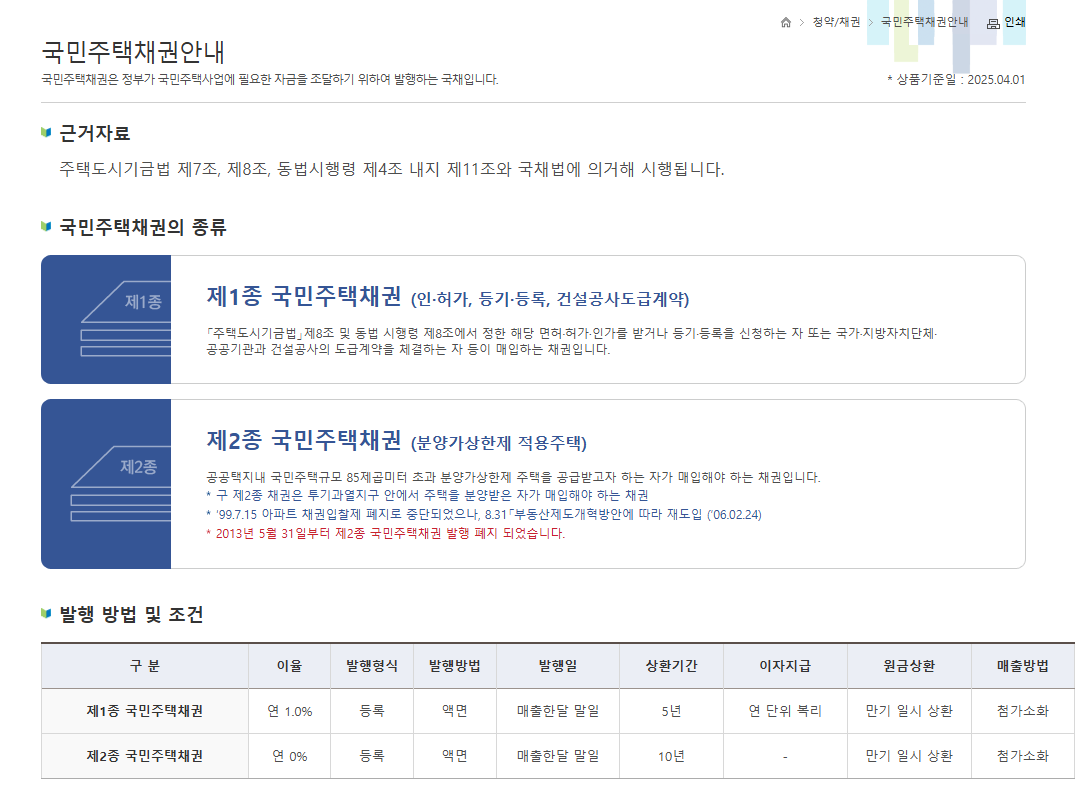
Where that discount comes from is the part nothing explains. The bond pays 1.0% a year over five years, compounded annually and repaid in one sum at the end. When the market wants more than 1.0% to hold five-year paper, nobody buys it at face value — and the gap between what it pays and what the market wants is the discount. So the discount is not a fee anyone charges you. It is the price of getting out of a below-market bond immediately instead of waiting five years.
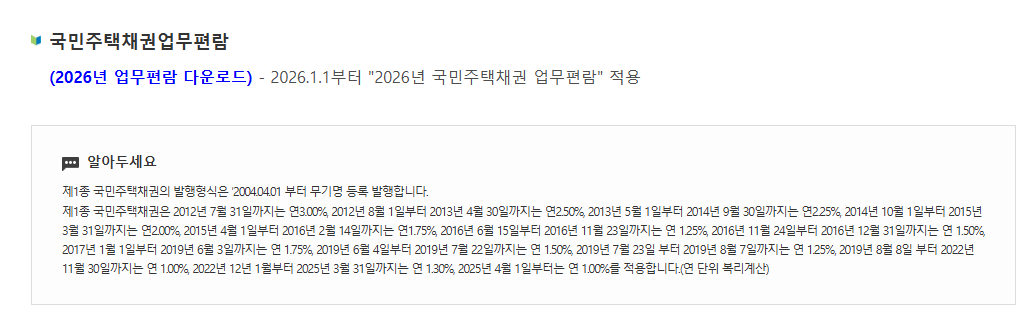
That coupon has moved a great deal: 3.00% until mid-2012, down to 1.00% by August 2019, up to 1.30% in December 2022, back to 1.00% from April 2025. Its full history is tracked here.
Buying jointly lowers the rate
Where a property is bought in more than one name, the assessed value is apportioned by each buyer's share and each buyer's rate comes from their own share's band, not from the whole. Two people splitting a home 50/50 can each land a band or two lower than one person buying it alone. On a couple's purchase that is worth checking before the registration is drawn up, because the saving is real and it is not recoverable afterwards.
One thing to ignore: if a guide mentions a Second-Class National Housing Bond, it is out of date. Issuance of those stopped on 31 May 2013.
Two things follow, and both matter on the day:
Stamp duty, and who is supposed to pay it
The Stamp Tax Act treats a document transferring ownership of real property as taxable. Where the stated amount is over ₩100,000,000 and up to ₩1,000,000,000, the stamp duty is ₩150,000. A ₩500,000,000 apartment contract sits in that band.
Where two or more parties draw up the document together, liability is joint. In practice buyer and seller often split it, but the law does not prescribe ₩75,000 each. Budget the full ₩150,000 on the buyer’s side and treat any split as a saving rather than an assumption.
What a ₩500,000,000 purchase actually needs in cash
Assuming: Seoul, one home after purchase, 85㎡ or under, agent fee at the cap, agent on the standard VAT regime, assessed value taken as ₩500,000,000 for illustration, a discount rate around 8.5%, and no first-time-buyer relief.
| Item | Expected cash |
|---|---|
| Acquisition tax | ₩5,000,000 |
| Local education tax | ₩500,000 |
| Rural special tax | ₩0 |
| Agent fee | ₩2,000,000 |
| VAT on the agent fee | ₩200,000 |
| Housing bond discount loss | ≈₩1,105,000 |
| Stamp duty | up to ₩150,000 |
| Scrivener fee and registration | ≈₩500,000–800,000 |
| Total | ≈₩9,455,000–9,755,000 |
If the assessed value is below the purchase price the bond cost falls. If you negotiate the agent’s fee below the cap it falls again. Go over 85㎡ and rural special tax adds roughly ₩1,000,000, taking the total to about ₩10,455,000–10,755,000.
The same headline price does not produce the same closing cost twice.
Leave a margin in the account on completion day
Structure the completion money as its own set of buckets rather than one figure:
Your share of the purchase price
+ acquisition tax and the taxes with it
+ agent fee
+ housing bond discount
+ scrivener and registration
+ stamp duty
+ a reserve
Matching the loan drawdown and your own funds to the last won, and running the balance down to nothing, is the mistake. The bond discount rate can move, a floor-area or homes-held judgement can change the acquisition tax, and registration disbursements can be added.
Get an estimate from the scrivener before contract, then recalculate acquisition tax, the bond cost and registration two or three days before completion.
Keep the receipts separated, for two later reasons
Ask for acquisition tax, local education tax, rural special tax, the bond purchase amount, the bond discount loss, the scrivener's fee and the registration disbursements as individual lines with their own receipts, not as "registration costs: ₩7,000,000".
They matter twice more. If you brought money in from abroad, the trail showing which account paid the price, the tax and the scrivener is what answers a source-of-funds question later. And when you eventually sell, acquisition-related costs are the material for the necessary-expense side of the capital gains calculation.
For a ₩500,000,000 apartment — one home, 85㎡ or under, Seoul, no relief — plan on roughly ₩9,500,000 to ₩10,000,000 in closing cash, held separately from the loan and from your share of the price.
Frequently asked questions
- Do foreigners pay a different rate of acquisition tax in Korea?
- No. Nationality alone does not change the rate. What sets it is who is acquiring, how many homes they will then hold, the price, the region and the nature of the dwelling. A foreign individual buying one home to live in is on the same schedule as a Korean individual doing the same thing — while a company, or an additional home in a regulated zone, moves onto the heavier schedule regardless of nationality.
- Do I really lose ₩13,000,000 on the national housing bond?
- No, and this is the most common misreading of a closing statement. You are required to buy that face value of First-Class National Housing Bonds, but most buyers sell them the same day rather than hold them. What you actually lose is the discount on that sale — roughly face value multiplied by the day’s discount rate. On a ₩13,000,000 purchase at a discount rate around 8.5%, that is about ₩1,105,000, not ₩13,000,000.
- Is the figure the scrivener quotes their fee?
- No. A judicial scrivener’s invoice mixes their own fee with money they are paying on your behalf: acquisition tax, registration application fees, certificate costs, the housing bond discount, VAT and sundry disbursements. Ask for those separated, and keep the individual receipts — treating the whole transfer as "the scrivener’s fee" hides both what you were charged and what you actually paid in tax.
- Is fire insurance a required closing cost?
- Not as a rule. Buying a home does not create a standalone fire insurance payment you must make before ownership can be registered, the way acquisition tax must be paid. Where a mortgage is involved, the lender’s collateral conditions, the building type and the existing cover may bring it in — and many apartment buildings already carry group cover arranged at building level. Do not put it in a closing budget as a fixed line.
The documents themselves
First-handNot a description of what the paperwork says — the paperwork. Every record states what was removed before it was published.
What the bond actually is1 September 2026
The First-Class bond is the one a property registration triggers. Its terms are on the bottom row: 1.0% a year, five-year maturity, annual compounding, repaid in a single sum. The Second-Class bond, which older guides still mention, stopped being issued on 31 May 2013 — if a source is telling you about it, the source is at least thirteen years out of date.
Nothing removed. A public information page on the Housing and Urban Fund site, carrying no personal or business information.
Fourteen years of the bond's coupon rate1 September 2026
The full run of rate changes as the fund publishes them: 3.00% until July 2012, down through 1.00% by August 2019, up to 1.30% in December 2022, back to 1.00% from April 2025. This is the coupon the bond pays — not the discount you take when selling it on the day, which moves with market yields and is the number that actually leaves your account.
Nothing removed. A public notice page, no personal or business information.
Figures in this guide we track
Last checked 4 September 2026- Housing acquisition tax rate1% ≤₩600M · 1–3% to ₩900M · 3% above2026-08-31
- Estate agent fee caps on a housing sale0.4% at ₩200M–900M, rising to 0.7% above ₩1.5B2026-08-31
- Housing bond purchase rate on a property transfer13 – 31 per 1,000, by value and region2026-09-01
- First-Class National Housing Bond coupon rate1.00%since 2025-04-01
These move. We check them on a schedule and keep the previous values, so you can see what a figure was, not only what it is.
Last verified:
Official sources
- Korea Law Information Center — Local Tax Act (acquisition tax on housing, local education tax)
- Korea Law Information Center — Stamp Tax Act (documents transferring ownership of real property)
- Korea Law Information Center — Enforcement Rule of the Licensed Real Estate Agents Act (brokerage fee limits)
- Korea Law Information Center — Housing and Urban Fund Act (First-Class National Housing Bonds)
- Seoul Metropolitan Government — brokerage fee schedule for property transactions
- Wetax — local tax filing and payment, including acquisition tax
- Housing and Urban Fund — National Housing Bond terms, rate history and the 2026 practice manual
Revision history
- Published
Figures here are re-checked against their official sources at least every six months. Substantive changes — a rate, a cap, a rule — are logged above rather than silently overwritten, and collected site-wide inupdates & revisions.
This article is general information, not financial, legal, or tax advice. Requirements and figures change; confirm the current rules with the official sources above before making decisions.