How to Register a Car in Korea as a Foreigner
Published Last verified
Buying a car and putting it in your name are two different steps, and for a foreign resident the second one has a reputation it does not deserve. The systems do overlap — your Residence Card, mandatory insurance, acquisition tax, local bonds, the registration authority and the Car365 portal — but the first question has a clean answer.
Three things Car365 states outright
From the new-registration guidance, read 30 September 2026
The rest of this guide is those three plus the table that says which cases the portal will take.
Yes, and the page says so in a table
Car365’s new-registration flow opens with an eligibility table, and the asterisk is the whole document: it marks the types the online service accepts.
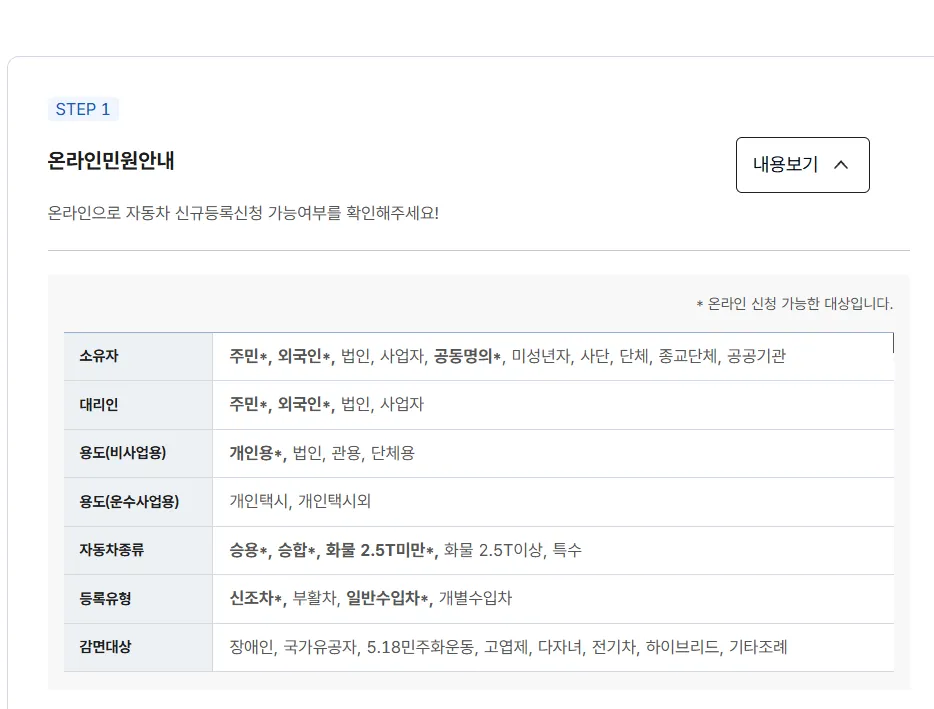
STEP 1, 온라인민원안내. 소유자 (owner) and 대리인 (representative) both carry 외국인 with an asterisk. Grey entries without one are the office's business, not the portal's.
Read down the rows and the picture is more specific than “foreigners can register a car”:
| Row | Accepted online | Not online |
|---|---|---|
| Owner | Resident, foreigner, corporation, sole trader, joint ownership | Minor, association, organisation, religious body, public institution |
| Representative | Resident, foreigner, corporation, sole trader | — |
| Use (non-commercial) | Private | Corporate, official, organisational |
| Use (transport business) | — | Private taxi, and everything else |
| Vehicle type | Passenger, van, goods under 2.5t | Goods 2.5t and over, special |
| Registration type | Newly built, ordinary import | Restored, individual import |
| Reduction category | — | Disability, national merit, 5·18, defoliant, multi-child, EV, hybrid, other by ordinance |
Two rows are worth pausing on. Joint ownership carries the asterisk — the portal does take it, so the common claim that two names always means an office visit is wrong for new registration. And the entire reduction row is grey, which is the sharpest line on the page: if you qualify for a reduction, the portal is not a slower route to it. It is the wrong route.
Insurance before the application, not after registration
The order most first-time buyers expect is buy, register, insure. Car365 puts insurance first, and makes it a gate:
의무보험은 신청전 반드시 가입하여야 하며 보험가입사실이 확인되어야 신청이 가능합니다.
Mandatory insurance must be taken out before the application, and the enrolment must be confirmed before the application is possible.
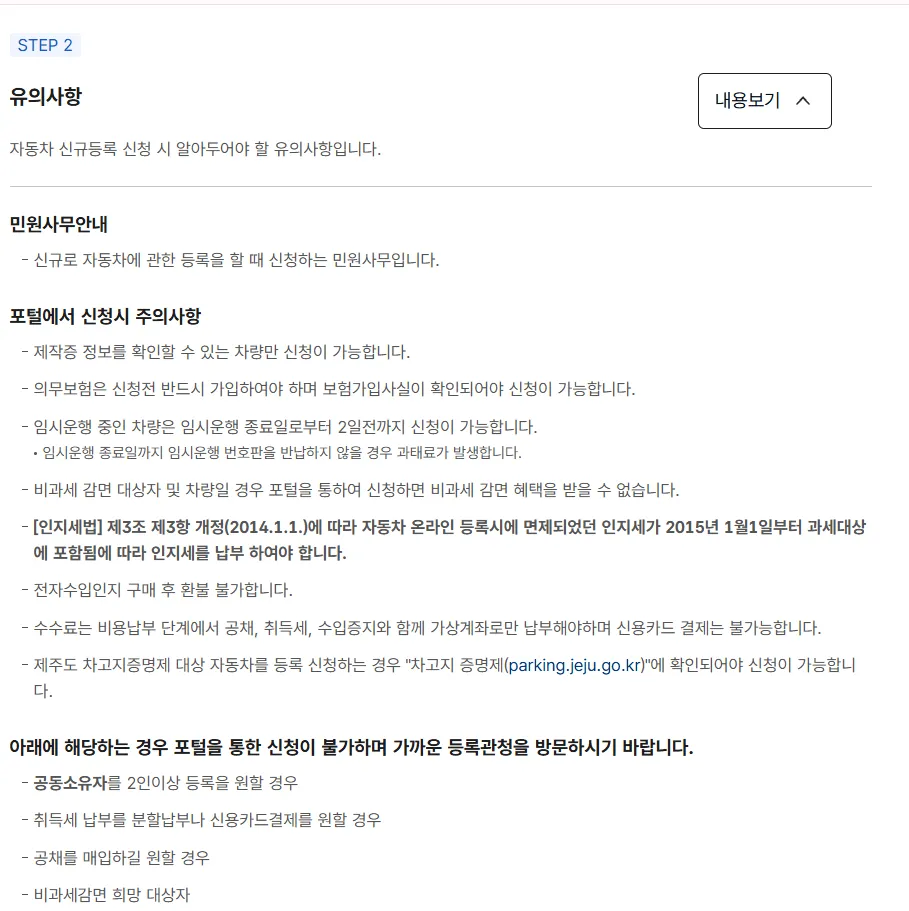
STEP 2, 유의사항. The insurance line is the second bullet. The virtual-account rule is near the bottom, and the four cases that send you to an office are the list below the bold line.
So the real sequence is:
confirm the purchase  →  take out mandatory insurance
                      →  registration application
                      →  bond, acquisition tax, fees
                      →  plates
For what the insurance itself costs and how driver limits work, that is a different guide: Korean car insurance for expats.
The conditions that catch people
The same STEP 2 panel carries five conditions that are easy to read past.
Only vehicles whose manufacturer certificate can be verified. The portal checks the 제작증 before it will take the application at all.
Temporary-operation plates have a deadline of their own. A vehicle on temporary operation can be applied for up to two days before the temporary period ends, and failing to return the temporary plates by that date brings a penalty.
A reduction claimed online is a reduction lost. The page does not say the benefit is delayed or has to be claimed separately — it says an eligible applicant or vehicle applying through the portal cannot receive it.
The stamp tax is not a portal fee. Online vehicle registration used to be exempt; an amendment to the Stamp Tax Act effective 1 January 2015 brought it into scope, which is why a stamp charge appears on an electronic filing at all. Electronic revenue stamps are not refundable once bought.
Payment is virtual-account only. Fees are paid at the cost-payment stage together with the bond, acquisition tax and revenue stamp, through a virtual account. Card payment is not available in this route.
Jeju has an extra gate
A vehicle subject to Jeju's parking-space certification cannot be applied for until that certification is confirmed at parking.jeju.go.kr. It is the one region-specific condition on the page.
Getting in: an account is not the only route
The portal has a non-member route, and it ends at an identity step with two methods.
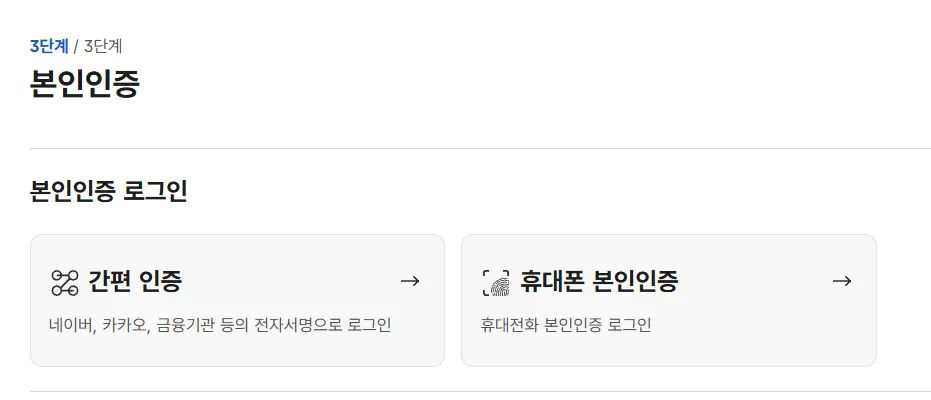
3단계 본인인증, the last of three. 간편 인증 signs in with an electronic signature from Naver, Kakao or a financial institution; 휴대폰 본인인증 uses mobile-phone verification.
Worth knowing before you plan an afternoon around it: what the screen does not say is whether either method will accept a given foreign registration number or a phone contract in your name. Those are properties of Korea’s identity infrastructure rather than of the vehicle portal, and this page does not speak for them.
That is the practical difference between the two facts this guide keeps separate. The right to register a car in your own name is settled, and the table above settles it. Whether every online step will go through on the first attempt is a different question, and the registration authority is one of the normal filing routes rather than a fallback for when it does not.
Four cases the portal will not take
Below the conditions, Car365 lists the situations that send you to a registration authority. The capture shows four:
- Registering three or more joint owners — two the portal takes, more it does not.
- Wanting to pay acquisition tax in instalments or by card.
- Wanting to buy the bond rather than take the discount route.
- Being an applicant who wants a non-taxable reduction.
Three of those four are choices rather than circumstances. You are not being excluded — you are asking for something the online route does not do, and the counter does.
Which registration is yours
Everything above is 신규등록, new registration, for a vehicle entering Korea’s register for the first time. A car that is already registered to somebody else uses a different procedure — 이전등록, transfer of ownership — where what changes is the registered owner rather than the record’s existence.
| You bought | The procedure |
|---|---|
| A brand-new car | New registration (신규등록) |
| A used car, privately | Transfer registration (이전등록) |
| A used car through a registered dealer | Transfer registration, normally filed by the dealer |
Car365 runs the transfer as its own five-step application, and the step names tell you where the work actually is: two of the five are about the vehicle and the transfer terms, and one is purely about documents.
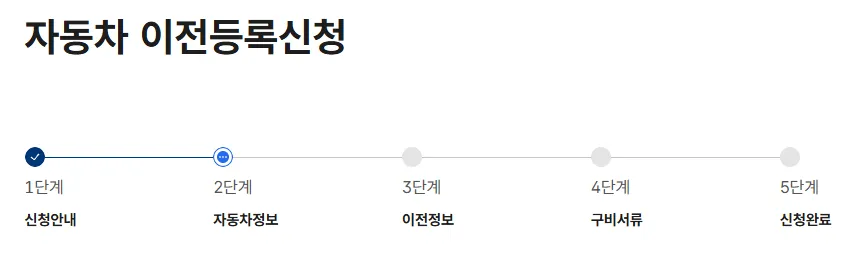
The rest of this guide is the transfer, because that is the route almost every foreign resident takes — and it is the one with a deadline.
The transfer has a deadline. New registration does not.
This is the single most important difference between the two procedures, and it is the thing most likely to cost you money. The transfer is not “file it when you get round to it”. The 신청시 주의사항 block states a statutory filing period that starts the moment the car changes hands, and states what happens if you miss it.
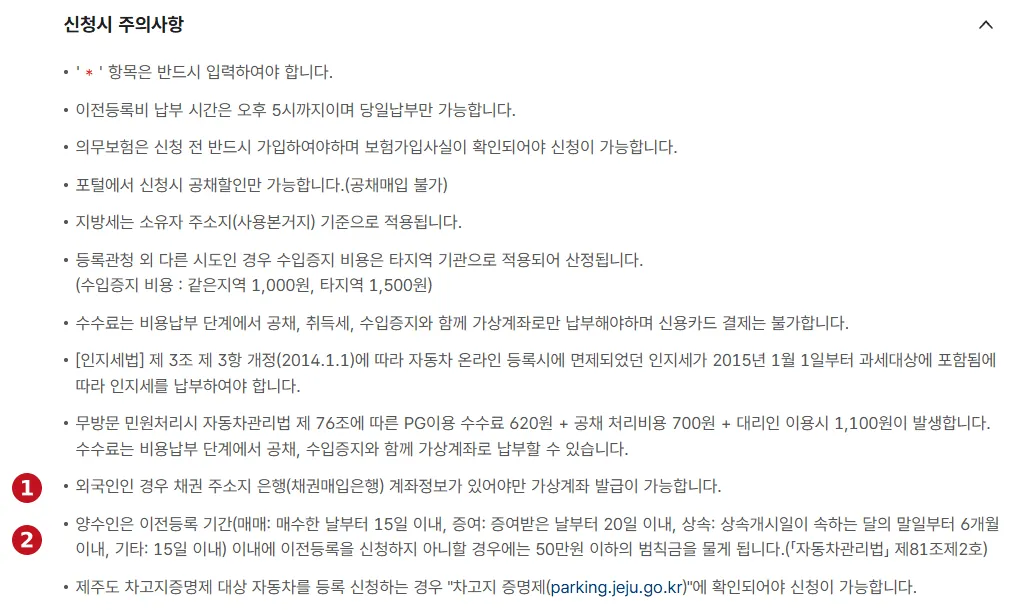
Marker ② is the deadline line. Read out:
| How you acquired it | You have |
|---|---|
| Purchase (매매) | 15 days |
| Gift (증여) | 20 days |
| Inheritance (상속) | 6 months |
| Other (기타) | 15 days |
The clock starts on the day you bought the car, or the day the gift was made. An inheritance is the exception and the generous one: the six months run from the end of the month in which the inheritance opened, not from the day.
Miss it and the page names the consequence: a fine of up to 500,000 won, under Article 81(2) of the Motor Vehicle Management Act. The obligation is on the 양수인 — the person receiving the car. That is you, the buyer.
The transfer certificate puts the same duty in contract terms. Article 6 makes the buyer responsible for everything that follows from not registering within the agreed period, and Article 8 says the certificate must be handed to the registration authority within 15 days of the final payment. So the clock the law runs and the clock your contract runs are the same clock.
The one line on this page that is about you
Marker ① is the line that does not apply to Korean buyers at all:
외국인인 경우 채권 주소지 은행(채권매입은행) 계좌정보가 있어야만 가상계좌 발급이 가능합니다.
For a foreign applicant, a virtual account can only be issued if account details are held at the bond bank.
Put that next to two other lines on the same screen and it stops being a footnote. Fees at the payment stage are payable by virtual account only, and card payment is not possible. If the virtual account cannot be issued, there is no second way to pay online.
So for a foreign resident the online transfer has a prerequisite the Korean route does not: an account at the relevant bank, in place before you reach the payment step. If you do not have a Korean account yet, that is the first task rather than a later one — see how to open a bank account in Korea as a foreigner.
Two more timing lines sit in the same block. Transfer fees can only be paid on the day, up to 17:00, and the portal takes applications 24 hours a day while completion only happens on weekdays between 09:00 and 18:00. A Friday evening filing is not a Friday evening transfer.
The buyer files it. The seller only consents.
Open the transfer application and Car365 says who is doing this before it says anything else.
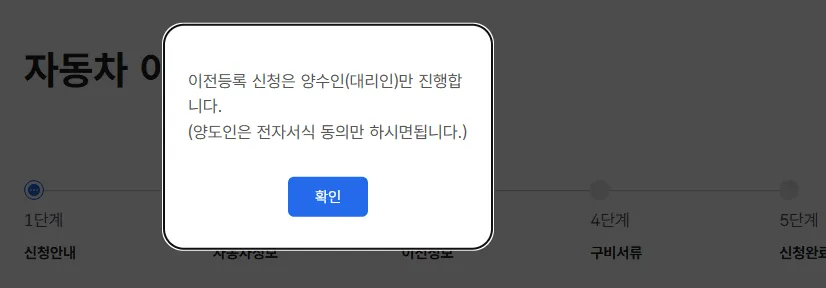
이전등록 신청은 양수인(대리인)만 진행합니다. (양도인은 전자서식 동의만 하시면 됩니다.)
Only the buyer, or their agent, makes the transfer application. The seller simply consents through the electronic form.
This is worth knowing before you agree anything with a private seller. The filing is yours, the deadline is yours and the fine is yours; what you need from the seller is their consent in the system, not their attendance at an office. An applicant-type step later in the flow lets you file 본인신청 yourself or 대리인신청 through an agent.
The foreigner selector is in the identity step
The same real-name step that new registration uses appears in the transfer flow, and the registration-number field carries a dropdown with two options — 주민 for a resident registration number, 외국인 for a foreign one.
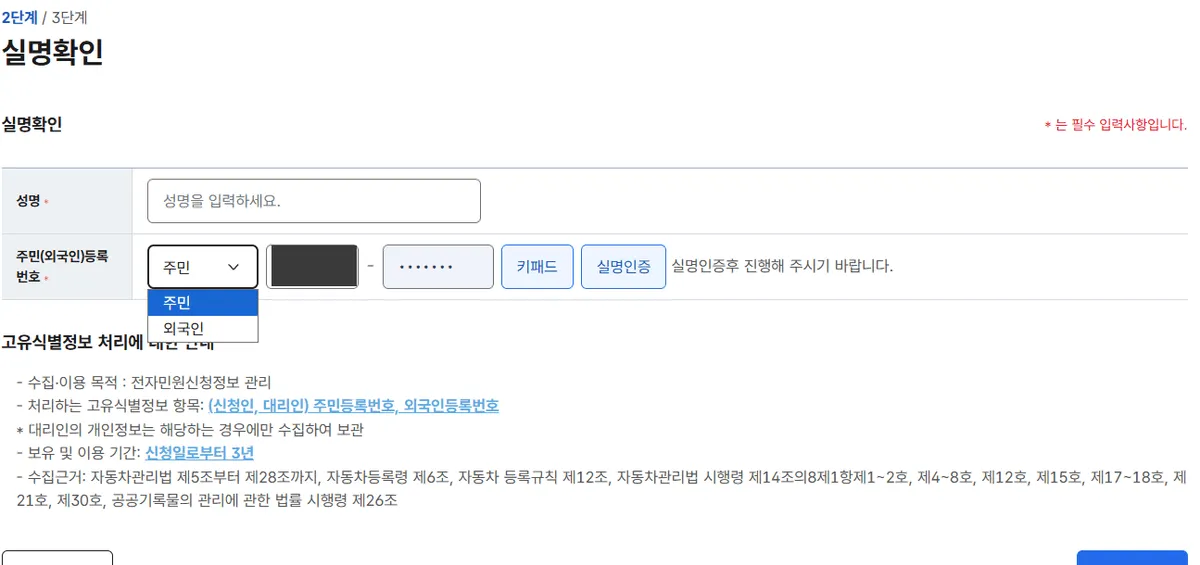
That selector is the practical confirmation of what the new-registration eligibility table states in words: the system is built to take a foreign registration number, not to tolerate one. The number on your Residence Card is the number this field wants — see how to register as a foreign resident in Korea if you do not have one yet.
The screen also states what it does with the number: it is collected to manage electronic application data, and kept for three years from the application date.
Buying privately: the certificate is the contract
A private sale between two individuals uses 자동차양도증명서, the transfer certificate, in the form prescribed by the vehicle registration rules. Car365 shows its terms in full before you agree to them, and four of them decide things people usually argue about later.
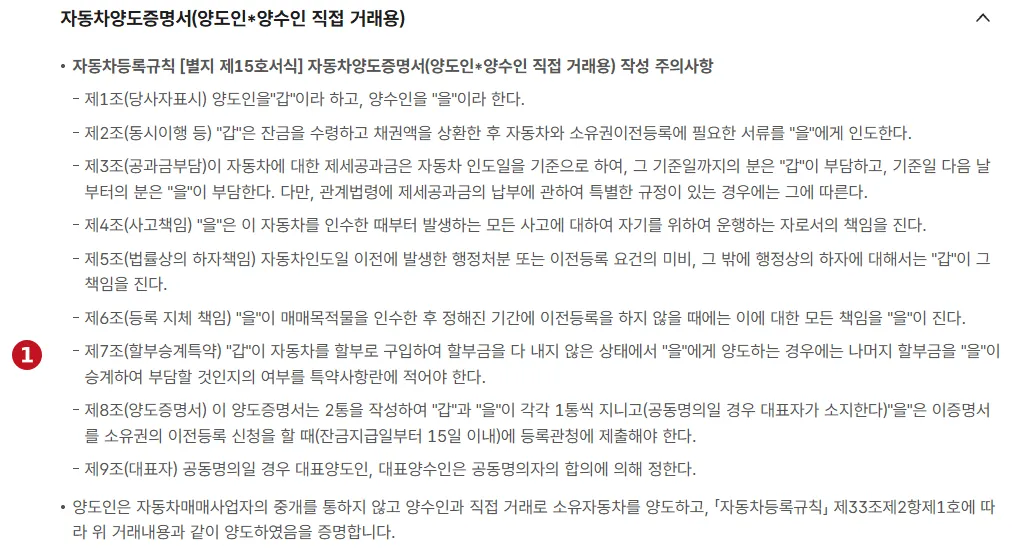
- Article 3 — who pays the charges. Taxes and public charges split at the handover date: the seller up to that day, the buyer from the day after.
- Article 4 — accidents. From the moment you take delivery, the car is driven for your account. Not from registration. From handover.
- Article 5 — defects in the paperwork. Administrative penalties and unmet transfer conditions arising before handover stay with the seller.
- Article 7 — the instalment clause, marked ① above. If the seller bought the car on 할부 and has not finished paying, whether you take over the remaining instalments has to be written into the special-terms box. A car with an unpaid loan on it is not a reason the sale cannot happen — it is a reason something has to be written down. How that financing works is in car loans in Korea for foreigners.
The certificate is drawn up in two copies, one for each party. The inspection, pricing and fraud side of a used purchase is in buying a used car in Korea as a foreigner.
What sends a transfer to the counter
The transfer’s exclusion list is considerably longer than the one for new registration. Car365 lists these as cases where the portal cannot take the application and you go to a registration authority instead:
- The vehicle has joint owners, or you want to register it with joint owners.
- You want to buy the bond rather than take the discount. Online, only the discount route exists.
- You are an applicant seeking a tax reduction — the page names large families, people with disabilities, national merit recipients, those injured in the May 18 Democratic Movement and Agent Orange sufferers, among others.
- The vehicle qualifies for a tax or bond reduction — hybrid, electric, hydrogen and hydrogen-electric vehicles, and cars under 1500cc in South Gyeongsang Province. The page is explicit that these need a local tax official’s decision and cannot be processed online at all.
- The plate is a regional-format plate (the example given is 서울1가1234).
- The car is corporate or commercial, or has ever been registered for commercial use.
- There is a seizure or a lien on it.
- It is subject to garage certification — goods vehicles of 2.5 tonnes or more, and special vehicles.
- It is a trailer or similar vehicle that does not carry insurance.
- The chassis number has been amended, so the change-of-use history cannot be confirmed.
- The acquisition value is 500,000 won or less and qualifies for reduction.
One more line sits with them and is not an exclusion but a warning: check the vehicle’s unpaid motorway tolls before applying.
The pattern from new registration repeats here. Most of this list is not about who you are — it is about asking for something the online route does not do.
The small fees, and the big ones this guide leaves alone
The transfer precautions screen does name its own minor charges, so there is no reason to be vague about them:
| Item | Stated amount |
|---|---|
| Revenue stamp (수입증지), same region | 1,000 won |
| Revenue stamp, different region | 1,500 won |
| PG payment fee, no-visit processing | 620 won |
| Bond handling | 700 won |
| Agent filing, if you use one | 1,100 won |
Stamp duty applies too: the page notes that vehicle registrations filed online lost their stamp-duty exemption on 1 January 2015.
Those are the small numbers. Acquisition tax, the local bond and the plates are the ones that decide what registration actually costs, and they turn on the vehicle, the local rules and the authority — local tax is assessed on the owner’s registered address — so they live in car ownership taxes and costs in Korea rather than here.
If the car is being financed, the lien sits on top of all of this: see car loans in Korea for foreigners. And when the car eventually leaves your name, that is selling or exporting your car when leaving Korea.
Before you start
- Work out whether yours is new registration or a transfer — only one of them has a deadline.
- If it is a transfer, put the 15-day date in your calendar on the day you pay.
- Open a Korean bank account first if you do not have one — the virtual account depends on it.
- Take out mandatory insurance and confirm the enrolment is on record.
- Have your Residence Card details ready — the number field accepts 외국인.
- Agree with the seller that they will give electronic consent, and when.
- In a private sale, settle the instalment clause in writing if the car still has a loan on it.
- Check the vehicle’s unpaid motorway tolls before you apply.
- Check your case against the exclusion list before assuming the portal will take it.
- Expect a virtual account, not a card — and pay before 17:00, same day.
- Budget for acquisition tax, bond and plates separately from the filing fee.
Bottom line
A foreign resident can register a vehicle in Korea, and the government’s own eligibility table is where that is written down rather than something you have to take on trust. The transfer flow goes further and puts a 외국인 option in the identity field itself.
What actually trips people is sequence and timing, not nationality. Insurance is a precondition. Payment is a virtual account, and for a foreign applicant that virtual account depends on a bank account you may not have opened yet. A reduction is the one thing where the convenient route costs you the benefit.
And if you have just bought a used car, the clock is already running: fifteen days, and the fine for missing it is yours, not the seller’s.
Frequently asked questions
- Can a foreigner register a car in Korea?
- Yes. The Car365 eligibility table for new registration names 외국인 — foreigner — as an owner who can apply, and marks it as one of the types the online service accepts. Foreigners are listed as eligible representatives too.
- Do I need insurance before or after registering?
- Before. Car365 states that mandatory insurance must be taken out before the application and that the enrolment has to be confirmed before the application can proceed. It is a precondition, not a next step.
- How long do I have to transfer a used car into my name?
- Fifteen days from the day you bought it. Car365 states the filing periods on the transfer application: 15 days for a purchase, 20 days for a gift, six months from the end of the month the inheritance opened for an inheritance, and 15 days otherwise. Missing it carries a fine of up to 500,000 won under Article 81(2) of the Motor Vehicle Management Act, and the duty falls on the buyer.
- Is there anything extra a foreigner needs for the online transfer?
- Yes, and it is on the precautions screen. Car365 states that for a foreign applicant a virtual account can only be issued if account details are held at the bond bank. Since fees at that stage are payable by virtual account only and card payment is not possible, a Korean bank account is a precondition for completing the transfer online rather than a convenience.
- Who files the transfer, the buyer or the seller?
- The buyer, or their agent. Car365 shows a popup at the start of the transfer application stating that only the 양수인 makes the application and the 양도인 simply consents through the electronic form. The filing, the deadline and the fine all sit with the buyer.
- Can I pay the registration costs by card?
- Not in the online route. Car365 says fees are paid at the cost-payment stage together with the bond, acquisition tax and revenue stamp, by virtual account only, and that card payment is not possible. Wanting to pay acquisition tax by card or in instalments is itself a reason to go to the office.
- I qualify for a tax exemption. Can I still apply online?
- You can, and you should not. Car365 warns that an applicant or vehicle eligible for a non-taxable reduction who applies through the portal cannot receive that benefit. This is stronger than an inconvenience — filing online forfeits it.
Last verified:
Official sources
- 자동차365 — 자동차 신규등록신청, STEP 1 온라인민원안내 and STEP 2 유의사항 (Ministry of Land, Infrastructure and Transport)
- 자동차365 — 자동차 이전등록신청 (ownership transfer)
Revision history
- Published
Figures here are re-checked against their official sources at least every six months. Substantive changes — a rate, a cap, a rule — are logged above rather than silently overwritten, and collected site-wide inupdates & revisions.
This article is general information, not financial, legal, or tax advice. Requirements and figures change; confirm the current rules with the official sources above before making decisions.