Registering an Employee for Korea’s Four Insurances
Published Last verified
Hiring is not finished when the contract is signed and the first salary goes out. Before that, you have to work out which of Korea’s four social insurances the person falls under — and file each one with the right agency, by its own deadline.
The four are not one system. National Pension, National Health Insurance, Employment Insurance and Industrial Accident Compensation Insurance each run on their own statute. The same employee, on the same contract, can be covered by one and excluded from another, and the day each filing is due is not the same day.
Hire on 1 March. Three deadlines fall on 15 April. One falls on 15 March.
Days available to file, for a start date on the 1st of the month
The combined portal merges the paperwork. It does not merge the deadlines.
The deadlines diverge, and that is the trap
| Insurance | What you file | Deadline | Agency |
|---|---|---|---|
| National Pension | Workplace subscriber acquisition | 15th of the month after the event | National Pension Service |
| Health insurance | Employee subscriber acquisition | Within 14 days of coverage starting | National Health Insurance Service |
| Employment insurance | Acquisition of insured status | 15th of the month after the event | Korea Workers’ Compensation & Welfare Service |
| Industrial accident | Employment, status and wage information | 15th of the month following the hire, subject to statutory exceptions | Korea Workers’ Compensation & Welfare Service |
The industrial accident line carries a genuine statutory exception rather than a soft “usually”: the Act on the Collection of Insurance Premiums fixes the 15th-of-the-following-month duty, and the Enforcement Decree then relieves some employees from being reported at all — short-hours work under 60 hours a month among them. That is an exception to the reporting duty, and it is not the same question as whether the person is covered, which the next section takes separately.
The Four Major Social Insurance Information Portal, and each agency’s own EDI system, will take several of these filings together. That convenience is where the mistake starts: submitting through one screen does not put the four on one statutory clock.
So the common practice — file last month’s new starters on the 15th — is late for health insurance for almost everyone. Someone who starts on the 3rd has a health deadline of the 17th, and the batch does not go out until the 15th of the next month.
If this is your first employee, there is a second question in front of all four: whether the workplace itself is registered for each insurance. Employee-level acquisition reporting assumes the workplace already exists in each system.
The wage you report is not the salary you agreed
Each insurance calculates on its own wage concept. National Pension uses a standard monthly income figure, health insurance uses a monthly remuneration figure, and employment and industrial accident insurance work from remuneration or an average monthly figure.
At the point of hire, all of them start from what the person is expected to earn for their work — base pay, position allowances, allowances paid on a fixed basis, regular bonuses — and then remove the pay that is exempt from income tax.
Two exemptions come up constantly:
Hours and contract shape decide coverage, not the job title
Whether someone is “full-time” or “contract” in your own vocabulary decides nothing. The working conditions do, and each insurance draws its line differently:
The first month is also charged differently depending on the start date. For National Pension, acquiring on the 1st means the contribution is charged for that month; acquiring on the 2nd or later normally starts the following month, though the employee may ask to pay for the acquisition month. For health insurance, acquiring employee status on the 2nd or later normally means no workplace contribution for that month, with charging from the next one.
A foreign employee’s visa alone does not decide this
The order that actually matters
Immigration law decides whether this person may do this job on this residence status. Social insurance sits downstream of that. Registering someone for the four insurances does not make employment lawful that the Immigration Act does not permit — and a D-10 job-seeking status is the clearest case where the first question is whether the activity is permitted at all, not which insurance applies.
| Status | Health | Pension | Employment | Industrial accident |
|---|---|---|---|---|
| F-2 · F-5 · F-6 | Covered if the employee test is met | Check nationality, reciprocity, treaty | Compulsory as a rule | Covered as a rule |
| E-7 | Covered if the employee test is met | Covered as a rule; check nationality and treaty | By application | Covered as a rule |
| F-4 | Covered if the employee test is met | Covered as a rule; check nationality and treaty | By application | Covered as a rule |
| E-9 · H-2 | Covered if the employee test is met | Check nationality and treaty | Voluntary under the current scheme | Covered as a rule |
Health insurance is not really a question about visa letters. It asks whether the person is lawfully working here and meets the employee subscriber test.
National Pension is the complicated one. A foreign employee is in principle covered at a Korean workplace, but three further questions follow: whether their home country gives Koreans an equivalent pension scheme, whether a social security agreement keeps them on their home scheme instead, and whether their residence status is itself excluded.
Employment insurance is where residence status matters most directly. F-2, F-5 and F-6 sit in compulsory coverage, while E-7 and F-4 are structured around applying for it.
Dependants are a separate filing again. Registering the employee does not automatically register their family. The relationship has to qualify, the income and asset conditions have to be met, and it has to be applied for — and a foreign family member may need documents proving the relationship.
There is also a waiting period that catches families relocating together. Anyone who entered Korea on or after 3 April 2024 must have lived here six months before they can be registered as a dependant. The exceptions apply from the day of entry, and the notice names them individually:
The real cost of filing late is not the fine
There is a claim that circulates in English-language advice that each unregistered employee costs ₩300,000 to ₩500,000. There is no such common rule. Each statute sets its own penalty:
- Under the National Pension Act, a failure to report or a false report by the employer carries a fine of up to ₩500,000.
- For employment insurance, the current administrative fine for failure to report — including late filing — is ₩30,000 per insured employee, subject to an aggregate cap of ₩1,000,000. False reporting is a separate, escalating schedule: ₩50,000 per person for a first offence, ₩80,000 for a second, ₩100,000 from the third.
- Health insurance and industrial accident insurance follow the violation-specific schedules in their own statutes.
In practice the retroactive assessment is the heavier problem. If employee status is confirmed later, or the acquisition date is corrected, contributions are charged backwards — and by then you have already paid salary without deducting the employee’s share. You now have to recover it from someone who has already spent it, alongside the employer’s share you also owe. The same thing happens when an employee files a claim to confirm insured status, or an agency audit finds the gap.
The order that keeps this stable
The contract itself, the minimum wage, the weekly holiday allowance and severance are covered in hiring your first employee, which is where the total cost of that ₩3,000,000 salary is worked out. Your own legal structure as the employer is in sole proprietor vs corporation.
Frequently asked questions
- Can I just file everything on the 15th of the following month?
- Not safely. Three of the four are due on the 15th of the month after the hire, but health insurance is due within 14 days of the day the employee becomes covered. Anyone who starts before roughly the 2nd of the month is already late by the time a monthly batch goes out. The combined portal lets you submit the filings together; it does not merge the statutory deadlines behind them.
- Is there really a ₩300,000–500,000 fine per unregistered employee?
- No. There is no single penalty of that shape covering all four insurances — each statute sets its own. Under the National Pension Act a failure to report or a false report carries a fine of up to ₩500,000. For employment insurance, the fine for failure to report, including late filing, is ₩30,000 per insured employee with an aggregate cap of ₩1,000,000; false reporting runs on a separate escalating schedule of ₩50,000, ₩80,000 and ₩100,000 per person. Health and industrial accident insurance follow the penalty schedules in their own statutes.
- My employee works 15 hours a week. Do I still register them?
- Probably for some of the four, and it is not one decision. Health insurance generally excludes employees working under 60 contracted hours a month. National Pension uses the same 60-hour starting point but can still cover someone employed for a month or more whose monthly income reaches the published floor. Employment insurance generally excludes work under 60 hours a month or 15 hours a week, but covers it where the work is the person’s livelihood and continues three months or more. Industrial accident insurance is not excluded on short hours as a rule at all.
- Does registering a foreign employee for social insurance make their work legal?
- No, and the order matters. Immigration law decides whether the person may do that job on that residence status; social insurance registration is downstream of that and does not cure a problem upstream of it. Confirm the status permits the work before you sign the contract, not after the filing.
The documents themselves
First-handNot a description of what the paperwork says — the paperwork. Every record states what was removed before it was published.
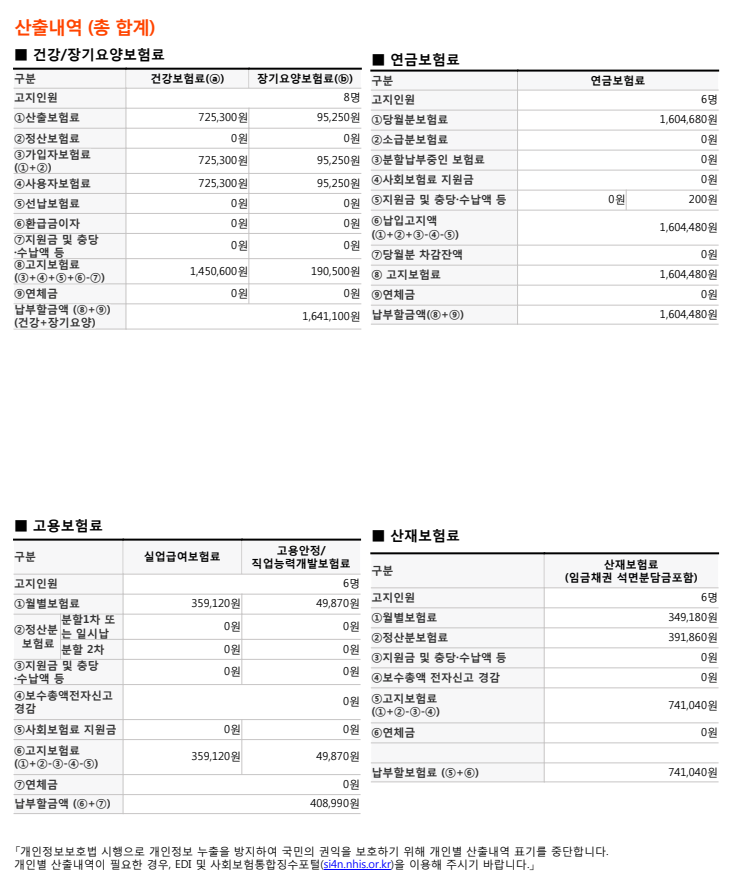
A real four-insurance bill, broken down24 August 2026
The August 2026 statement for a Korean workplace of six to eight insured people. The line worth finding is in the first table: 가입자보험료 ₩725,300 and 사용자보험료 ₩725,300 — the employee's share and the employer's share, identical, on the same bill. The same split runs through long-term care at ₩95,250 each. Health and long-term care together come to ₩1,641,100, pension ₩1,604,480, employment ₩408,990 and industrial accident ₩741,040. Employment insurance is the one that is not split evenly: it separates unemployment benefit (₩359,120) from employment stability and vocational development (₩49,870), and industrial accident is the employer's alone.
Cropped to the calculation page. The workplace name, management number, payer number, electronic payment number, the payment-only account numbers and the payment QR code are on other pages of the notice and are not included here. The insured headcount is left in — without it the amounts mean nothing.
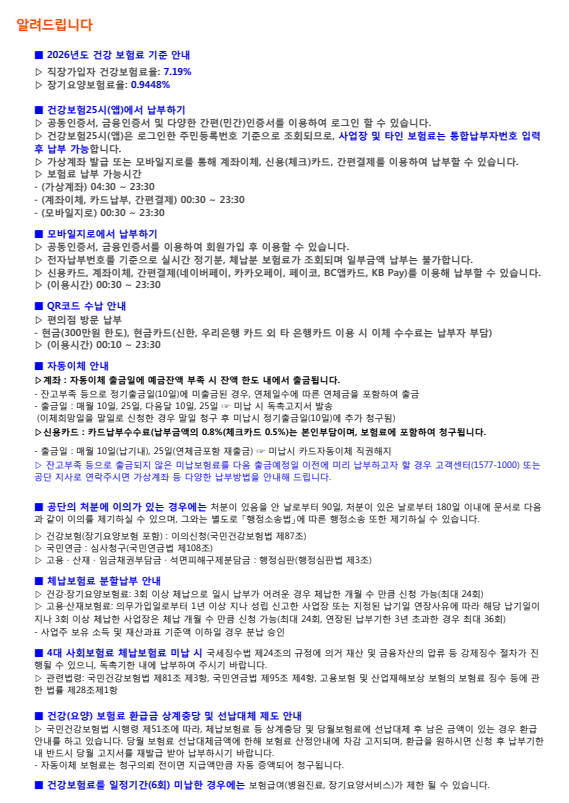
2026 contribution rates, as printed on the bill24 August 2026
The rates this site quotes, printed on an actual statement rather than taken from a guide: employee health insurance 7.19%, long-term care 0.9448%. Long-term care is expressed here as a percentage of income, which is the figure that reconciles with the 13.14%-of-the-health-contribution formulation used elsewhere.
Nothing removed. This page of the notice carries no identifying information — it is the standard guidance printed for every recipient.
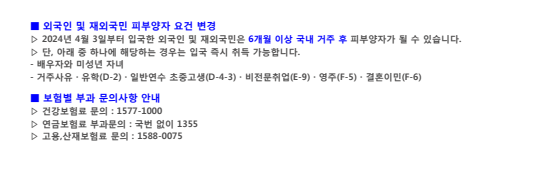
The six-month wait before a foreign dependant is covered24 August 2026
For anyone who entered Korea on or after 3 April 2024, six months of domestic residence is required before they can be registered as a dependant. The exceptions take effect immediately on entry: a spouse and minor children, and a set of residence statuses the notice names individually — study (D-2), general training for primary and secondary students (D-4-3), non-professional employment (E-9), permanent residence (F-5) and marriage migration (F-6), alongside residence-purpose status.
Nothing removed. Standard guidance printed on the notice, with no identifying information.
Figures in this guide we track
Last checked 1 September 2026- National Pension contribution rate9.5%since 2026-01-01
- National Health Insurance contribution rate7.19%since 2026-01-01
- Pension income floor for short-hours work₩2,200,0002026-01-01
- Pension standard monthly income limits₩410,000 – ₩6,590,0002026-07-01
- Meal allowance exempt from income tax₩200,0002026-08-31
- Residence required before a foreign dependant is covered6 months2024-04-03
These move. We check them on a schedule and keep the previous values, so you can see what a figure was, not only what it is.
Last verified:
Official sources
- Korea Law Information Center — Act on the Collection of Insurance Premiums for Employment Insurance and Industrial Accident Compensation Insurance, art. 16-10(3)
- Korea Law Information Center — Enforcement Decree of the Employment Insurance Act, Appendix 3 (administrative fine schedule)
- National Pension Service — 2026 Easy Guide to Workplace National Pension Administration
- National Pension Service — standard monthly income upper and lower limits
- National Health Insurance Service EDI — workplace insured person acquisition report guide
- National Pension Act
- National Health Insurance Act
- Four Major Social Insurance Information Portal — combined acquisition reporting
- Korea Workers’ Compensation & Welfare Service
Revision history
- Published
Figures here are re-checked against their official sources at least every six months. Substantive changes — a rate, a cap, a rule — are logged above rather than silently overwritten, and collected site-wide inupdates & revisions.
This article is general information, not financial, legal, or tax advice. Requirements and figures change; confirm the current rules with the official sources above before making decisions.