Registering a Business Credit Card on Hometax
Published Last verified
The point of a business credit card is not the card. It is that the National Tax Service can collect its transaction data directly from the card company, so that hundreds of purchases arrive at VAT time as filing data rather than as a box of receipts to key in.
How the general and simplified VAT regimes themselves work is a separate question — Korean VAT for small business owners covers that. This guide is only the card data: how it is collected, and how deductible and non-deductible are decided.
What registration does and does not do
The most expensive misunderstanding in small-business bookkeeping here
Automation does not remove the judgement. It gathers up the transactions that need one.
Where it is, and what it will not take
In Hometax:
Log in → Invoices · Receipts · Cards
       → Credit card purchases
       → Business credit card registration and enquiry
An individual business can register up to 50 cards, and the field on the screen says exactly which: credit cards and check cards in the name of the representative or the company. They do not have to be cards opened specifically for the business — an ordinary personal credit card in the owner’s name can be registered.
A mobile number is required alongside the card numbers. It is not optional politeness: it is where the SMS goes if a card number is mistyped, and clearing all the card numbers clears the phone number with them.
What the scheme will not take:
A card registered this month can be checked for an identity match from around the 10th of next month, and usage history has been available monthly for registrations from October 2019 onward. So if a new card is going to carry business spending, register it before you start using it, not after the first statement.
One card type to keep out deliberately: fuel usage on a freight driver welfare card is queried through its own menu, and the screen asks you not to register it here.
Get the number right the first time
The registration list shows each card with a request date, a confirmation date and a processing status — and while that status reads 확인요청중 (confirmation requested), the entry cannot be deleted. A mistyped card number is not a quick fix; it is a wait. Check the digits before submitting rather than after.
Individual and corporate cards are collected differently
| Individual business | Company | |
|---|---|---|
| Card is in the name of | The business owner | The company |
| Separate Hometax registration | Required | Not normally required |
| How many | Up to 50 credit cards in the owner’s name | Company-name cards handled automatically |
| Family cards | Excluded | Different structure |
| Seeing the transactions | In Hometax after registering | Collected as corporate card data |
| Who decides deductibility | The business owner | The company, on the substance |
A card issued in a company’s name is already tied to the company, so there is nothing to register.
Which is not the same as “paid on the corporate card, therefore deductible and expensed.” A director’s personal purchases, a family meal, a private trip — the name on the card does not make any of that a business cost. Corporate cards automate collection. They do not decide business relatedness.
The tax office sorts first. You decide last
Registered card data goes from the card company to the National Tax Service, which analyses it against the counterparty’s registration status and industry classification. Hometax then shows each transaction in one of three states:
The confirmation screen for input tax deduction is where you settle those, and settling them is your job, not the system’s. Data that shows up marked deductible is not a ruling. A meal with no business purpose does not become deductible under the Value-Added Tax Act because a classification engine put it in the wrong bucket.
What never deducts, whatever card paid for it
| Transaction | VAT treatment |
|---|---|
| Ordinary purchases used directly in the taxable business | Deductible where the conditions are met |
| Personal spending unrelated to the business | Not deductible |
| Entertainment and similar consumption-type spending | Not deductible |
| Buying, leasing or running a non-commercial small passenger car | Not deductible as a rule |
| Purchases used in a VAT-exempt business | Not deductible |
| Buying from a VAT-exempt business | No input tax to deduct |
| Purchases from a simplified taxpayer | Pre-sorted as inherently non-deductible |
| Shared across taxable and exempt activities | Apportionment required |
Two of those cost people real money:
Entertainment. A meal with a client, a round of golf — genuinely connected to the business in an ordinary sense, and still treated by the Value-Added Tax Act as its own non-deductible category. The VAT inside entertainment spending does not deduct the way VAT on materials does.
Non-commercial small passenger cars. Using a car for work does not make it deductible. Purchase, lease and running costs including fuel and servicing are, as a rule, outside input tax deduction. Where the vehicle itself is the business — car dealing, vehicle rental — the analysis is different, and that is a narrow exception rather than a general escape.
Costs relating to a VAT-exempt business cannot be set against the output tax of a taxable one either. Where a cost genuinely serves both, common input tax has to be apportioned.
VAT deduction and expense deduction are two different tests
Non-deductible for VAT does not mean disallowed as an expense
These are separate statutes answering separate questions. VAT input tax not being deductible does not automatically mean the whole payment is refused as a necessary expense or a deductible cost for income or corporate tax. And the reverse trap is more common: a transaction arriving automatically in Hometax is not thereby an allowable expense under the Income Tax Act or the Corporate Tax Act.
Run them as an ordered sequence rather than one decision:
Card payment
  → is it business related?
  → is the VAT input tax deductible?
  → is the amount an allowable expense for income or corporate tax?
An unregistered card is not a void card
Not registering does not remove the expense from your business. What you lose is automatic collection, which means evidencing each transaction separately — the exact work the scheme exists to remove.
From 2026, validation on the individual electronic VAT return has been tightened: with no registration history, amounts cannot simply be entered into the business card field of the return. Continuing on unregistered cards is not an efficient way to manage tax records.
But the claim that non-registration itself attracts penalty tax is not accurate. The real exposure sits elsewhere: deducting input tax that never qualified, entering the same transaction twice from different card statements, or putting private spending through as deductible. The National Tax Service can assess the input tax back and apply penalty tax on those.
Do not meet the classification for the first time in filing week
The whole point is to remove the receipt-gathering sprint before the deadline. Meeting several hundred pre-classified transactions for the first time on the day you file recreates it.
Check the Hometax record monthly or quarterly, and look hardest at:
The setup that stays clean
Separate the account, the card and the evidence at the same time, right after registering the business:
A company should build the same control around a corporate account and corporate cards. Repeatedly paying company costs on the director’s personal card and reimbursing afterwards makes the evidence trail and the cash flow harder to follow than they need to be.
The value of registering a business card is not that it deducts more tax. It is that it stops you missing deductions you were entitled to, strips out the ones you were never entitled to before you file them, and turns several hundred card payments into something you can actually file from.
Frequently asked questions
- Does registering a card on Hometax get me a bigger deduction?
- No. Registration does not make a non-deductible transaction deductible. It lets the National Tax Service collect your card data from the card companies so that purchases which already qualify arrive as filing data instead of as a shoebox of receipts. The deduction rules are untouched by it.
- Can I register my spouse’s card, or an employee’s?
- No. The registration screen takes credit cards and check cards in the name of the representative or the company, plus rechargeable prepaid cards converted to a registered name — gift cards only — up to 50 of them. Family cards, gift cards, unregistered rechargeable prepaid cards, 직불카드 and department store cards are all refused, and an employee’s personal card cannot be registered against your business registration number. If staff need to spend, that is a corporate card or a reimbursement process, not this.
- Do corporate cards need registering too?
- No. A card issued in the company’s name is already linked to the company, so there is no separate registration. That is a data-collection convenience and nothing more — paying a director’s personal shopping, a family meal or a private trip on a corporate card does not make it a business cost because the card has the company’s name on it.
- Is there a penalty for not registering a business card?
- Not for the non-registration itself, and guidance claiming otherwise is wrong. What you lose is the automatic collection, so every transaction has to be evidenced separately — and from 2026 the electronic VAT return validates against registration history, so amounts cannot simply be typed into the business card field without it. The real exposure is elsewhere: deducting something that never qualified, entering the same transaction twice from different card statements, or claiming private spending. Those draw an assessment and penalty tax.
The documents themselves
First-handNot a description of what the paperwork says — the paperwork. Every record states what was removed before it was published.
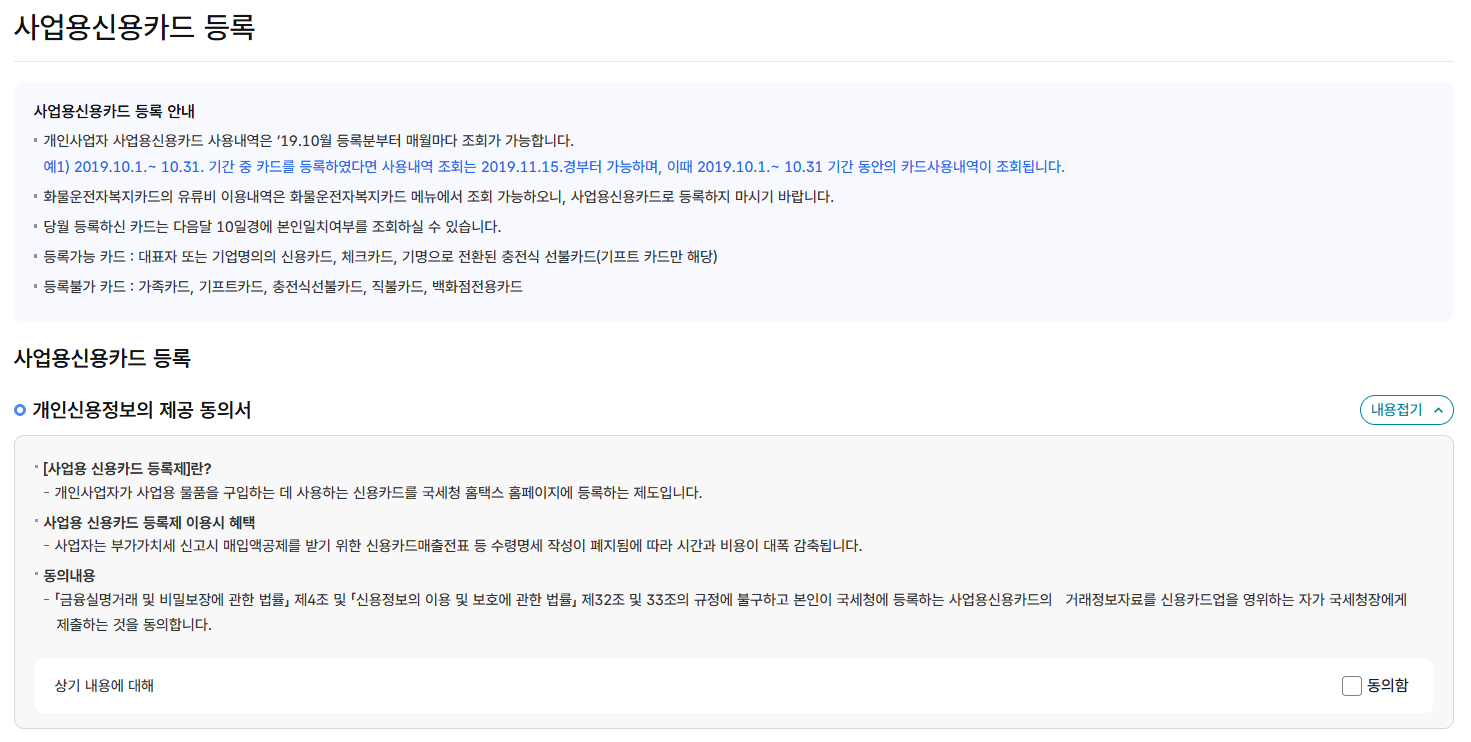
Which cards Hometax will and will not register1 September 2026
The eligibility list as the National Tax Service words it. Accepted: credit cards and check cards in the name of the representative or the company, and rechargeable prepaid cards converted to a registered name — gift cards only. Refused: family cards, gift cards, rechargeable prepaid cards, 직불카드 and department store cards. Note that a check card is accepted while 직불카드 is not; English guides that translate both as 'debit card' get this backwards. The screen also asks that a freight driver welfare card be kept out, and states that a card registered this month can be checked for an identity match from around the 10th of next month.
Browser chrome cropped away. Nothing on the page itself was masked — no business registration number or trade name had been selected.
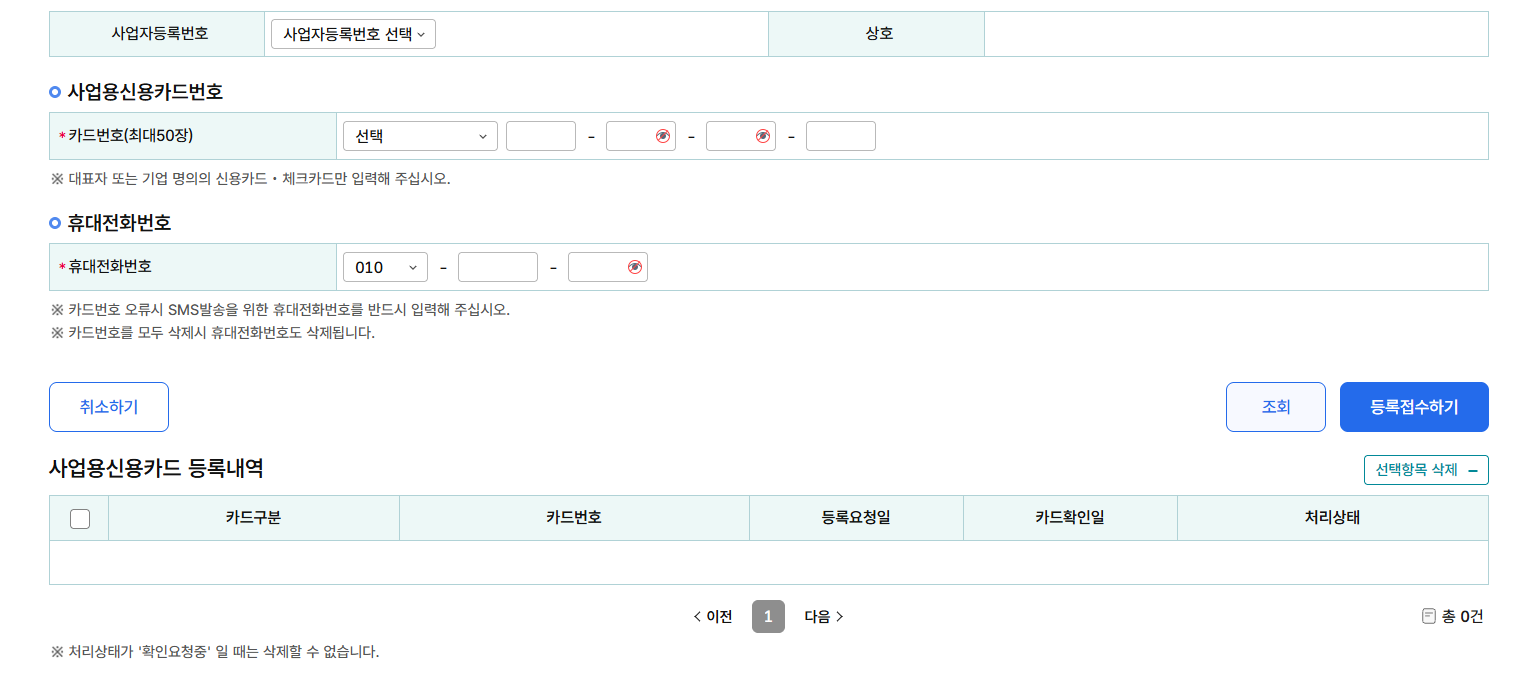
The registration form itself, empty1 September 2026
The card number field is labelled 최대50장 — the 50-card cap, on the screen rather than in a guide. Beneath it: 대표자 또는 기업 명의의 신용카드·체크카드만, confirming check cards are in. A mobile number is mandatory because that is where the SMS goes if a card number is wrong, and clearing the card numbers clears it too. The registration list below shows the columns you will be reading later — card type, number, request date, confirmation date and processing status — with the warning that an entry cannot be deleted while the status reads 확인요청중.
Browser chrome cropped away. Nothing masked: the form was blank, with no business registration number, trade name, card numbers or phone number entered, and the registration list empty at 총 0건.
Figures in this guide we track
Last checked 5 September 2026- Business cards registerable on Hometax50 cards2026-08-31
- Simplified VAT taxpayer threshold₩104,000,0002026-08-31
These move. We check them on a schedule and keep the previous values, so you can see what a figure was, not only what it is.
Last verified:
Official sources
- Korea Law Information Center — Value-Added Tax Act (input tax not eligible for deduction)
- Korea Law Information Center — Income Tax Act (necessary expenses)
- Hometax — business credit card registration and enquiry
- National Tax Service — VAT filing and input tax deduction guidance
Revision history
- Published
Figures here are re-checked against their official sources at least every six months. Substantive changes — a rate, a cap, a rule — are logged above rather than silently overwritten, and collected site-wide inupdates & revisions.
This article is general information, not financial, legal, or tax advice. Requirements and figures change; confirm the current rules with the official sources above before making decisions.